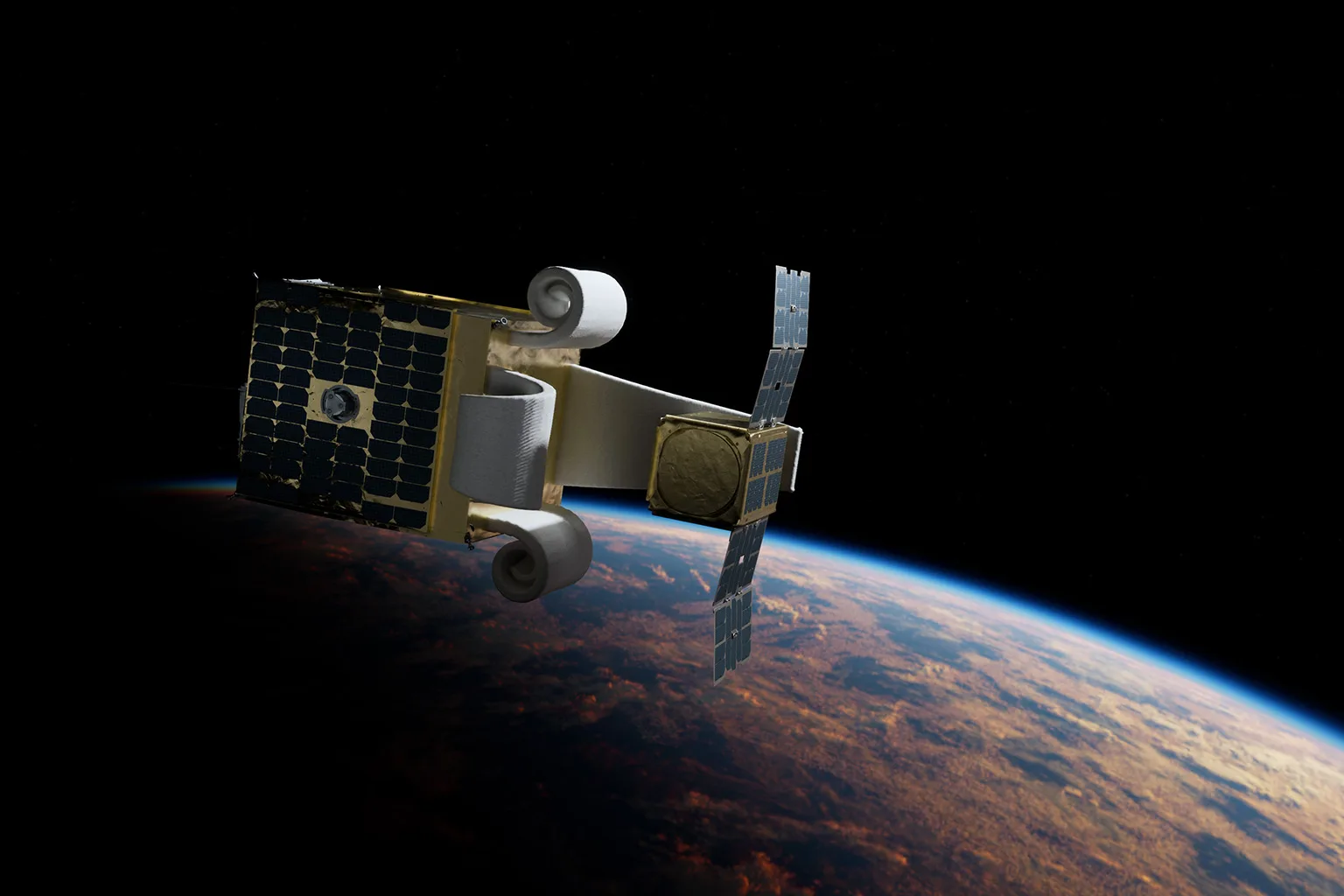
Cosmoserve Space, a Hyderabad startup developing robotic spacecraft to capture defunct satellites and debris, raised $6m in a seed round announced on 5 November 2026.
Tokyo-based Rebright Partners led the round, according to Inc42 and Indian Startup News. The company's own announcement lists Rebright alongside the other backers without naming a lead. New investors Aranya Holdings and Naandi Ventures joined, and existing backers AUM Ventures and Shakti VC put in more money.
The company said the round brings its total funding to more than $9m since it was set up in June 2025. It did not disclose a valuation. Founder Chiranjeevi Phanindra told Inc42 that the valuation has roughly doubled since the company's pre-seed round.
“Debris is becoming the limiting factor for every nation's space ambitions, including India's.”Chiranjeevi Phanindra, Founder and CEO, Cosmoserve Space
What Cosmoserve does
Cosmoserve is building spacecraft to remove dead satellites and debris from orbit, so that working satellites face less risk of collision. Its main technology is a soft robotic capture system that uses flexible petals rather than rigid arms. The company is also developing vision-based navigation.
Its design pairs two spacecraft. A larger Orbital Service Station would act as a logistics hub in orbit, carrying fuel, equipment and spare parts. A smaller Autonomous Service Vehicle would travel between satellites to capture, dock with, diagnose, repair or remove them. Cosmoserve says one such pair could serve up to 100 satellites and bring the cost of servicing one satellite down from around $10m to under $1m. These figures come from the company and have not been tested in orbit.
The company cites figures that put about 28,000 satellites in orbit, nearly 10,000 of them dead or not working, and about 660 recorded collisions and explosions that have produced close to 58,000 tracked fragments.
Base 1 and the first mission
Cosmoserve opened its new facility, Base 1, at the same time as the funding announcement. According to Indian Startup News, the site covers about 14,800 sq ft at VSD Tech Park in Gachibowli, and Inc42 reported that it cost around ₹6 crore (about $0.64m) to build. It contains an orbital rendezvous and capture lab, a space robotics lab, an ISO Class 8 clean room for satellite integration and a mission simulation and control centre. Union Minister of State for Science and Technology Jitendra Singh and Telangana IT Minister D Sridhar Babu attended the opening.
The company says it sources about 60% of its mission components in India and wants to make more of its optics, avionics and space-grade electronics itself.
Its first payload, Mission Embrace, flew in July 2026 on Skyroot Aerospace's Vikram-1 rocket. The hardware was built in under four months, but the robotic petals did not open in orbit. Cosmoserve told Inc42 it had traced the likely causes to the thermal release mechanism and the effect of low temperatures.
"Debris is becoming the limiting factor for every nation's space ambitions, including India's," Phanindra said in the company's announcement.
What the money is for
Cosmoserve said the seed money will pay for Base 1, further technology demonstrations and two upcoming missions. In 2027 it plans to test its capture system on microgravity flights, fly an upgraded version of the first mission, called Embrace-2, and attempt a full-scale capture demonstration. Indian Startup News reported that the demonstration aims to bring the spacecraft within 10 metres of a dead satellite.
The company is targeting commercial operations in 2028. Phanindra told Inc42 it holds letters of intent from satellite constellation operators, one each in the US and Europe and two in India, and aims to sign one paying customer before commercial service begins.
The funding so far
Cosmoserve raised a $3.17m pre-seed round in September 2025, led by angel investor Alan Rutledge through US firm AVCF, according to Indian Startup News. AUM Ventures and Shakti VC also backed that round.
Rebright's Takeshi Ebihara called space debris a problem shared by every country. The company said this is Rebright's first investment in a space technology company. Phanindra spent about 15 years at ISRO, where he worked on the Gaganyaan human spaceflight programme, before founding Cosmoserve.
Company website: cosmoserve.space