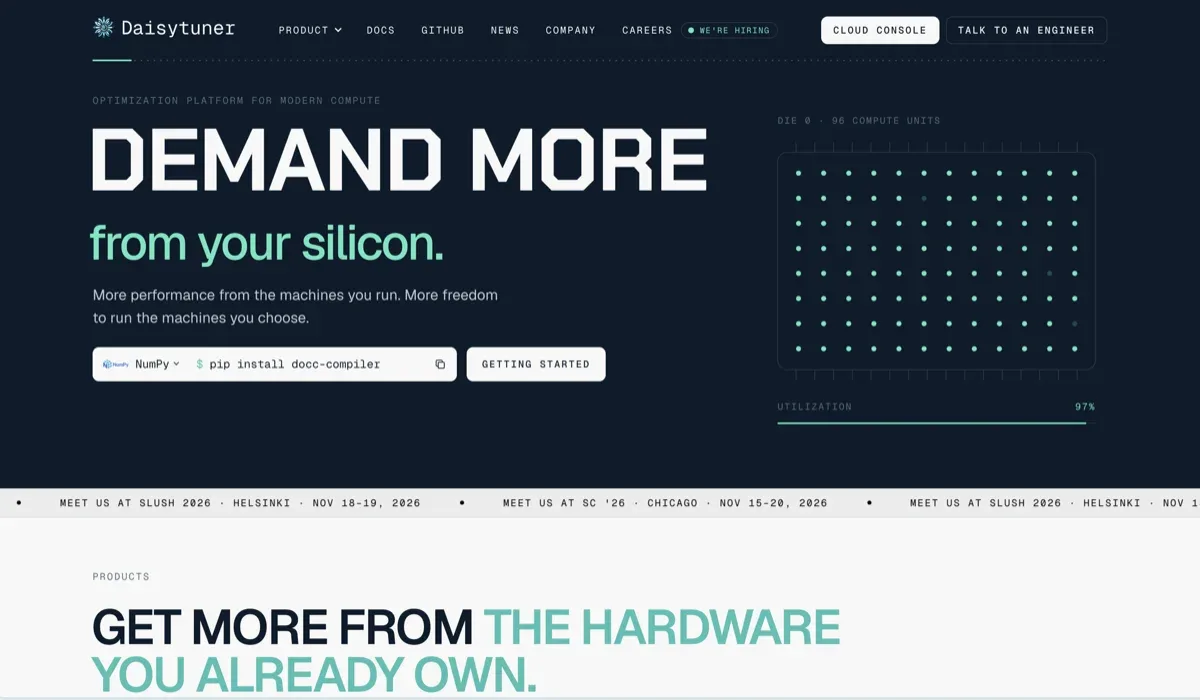
Daisytuner, a German company that builds compilers to make software run efficiently on different kinds of chips, announced on 16 November 2026 that it had raised €6m (about $6.6m) in seed funding.
Elaia and LEA Ventures co-led the round, with Amadeus APEX Technology Fund and Seedcamp also investing. The company did not disclose a valuation.
Daisytuner announced the funding on the same day it released Daisyflow, an engine for running AI models in production that companies can host in their own data centres rather than through an outside AI cloud provider.
What Daisytuner does
Every new AI model or processor tends to require fresh, manual tuning so that code runs well on it, work that Daisytuner says has mostly been limited to large AI labs and the newest hardware. The company aims to automate that tuning.
Its open-source compiler, docc, converts code written with PyTorch, NumPy or C and C++ into a dataflow representation and then generates native code for CUDA, ROCm and newer chip architectures. AI agents search for possible optimisations and test them on real hardware, and the compiler checks that each change is correct before it is used. Verified optimisations go into a performance database so they can be applied to similar code later.
Daisyflow adds a full serving layer on top, handling language, vision, speech and recommendation models with batching, routing and APIs compatible with OpenAI's. In a company benchmark, Daisytuner said Alibaba's Qwen 2.5 model ran up to 18% faster on AMD Instinct GPUs than on vLLM, which the company called the industry standard. Tech.eu noted that the result had not been independently verified.
The company also sells a hosted version of its platform and a self-hosted enterprise edition with a service-level agreement. It is aiming at cloud providers with mixed hardware fleets, enterprises that want control over their data, and chipmakers that want new processors in production quickly. It has not named customers.
Founders and team
Lukas Truemper, the chief executive, founded Daisytuner based on his research into AI-driven compilers at ETH Zurich, according to the company's website. Co-founder Adrian Schmitz works on its GPU optimisation technology. Tal Ben-Nun, a staff scientist at Lawrence Livermore National Laboratory, is a scientific adviser.
The company said its staff come from ETH Zurich, TU Munich, RWTH Aachen, TU Darmstadt and Lawrence Livermore National Laboratory. It did not give a headcount. In December 2024, Daisytuner and ETH Zurich's Scalable Parallel Computing Laboratory received a HiPEAC technology transfer award for moving compiler research into industry.
The funding so far
Tech.eu's funding database lists Daisytuner as founded in 2024 and records one earlier round of €1.1m (about $1.2m at November 2026 exchange rates) in May 2025. LEA Partners, angel network Angel Invest Ventures and several individual angels backed that round, including Codesphere founder Elias Schneider and angel investor Mario Götze.
Daisytuner said it will use the new money to bring Daisyflow to more enterprises, hire, and extend its compiler technology.
Company website: daisytuner.com