Dcubed, a German maker of release actuators, deployable structures and solar arrays for spacecraft, said on 18 November 2026 that it had closed an oversubscribed €27.2m (about $29.8m) Series A+ round led by Warsaw Equity Group (WEG).
The European Innovation Council (EIC) Fund and the HTGF Opportunity Fund joined the round, along with existing investors including BayBG and Expansion. Dcubed did not disclose a valuation.
The company said it now has more than 170 customers around the world and more than 500 of its products in space. It said production and revenue had more than doubled year on year, and that it employs 87 people across Germany and the United States.
“Demand for our products is going through the roof. We are scaling Dcubed to become the global category leader in space deployment and power systems.”Thomas Sinn, CEO and Founder, Dcubed
What Dcubed makes
Dcubed's main products are release actuators, the mechanisms that hold parts such as solar panels in place during launch and free them once a satellite is in orbit, along with deployable structures and solar arrays. The company sells standard, ready-to-order hardware rather than designing each part for a single mission, which it presents as an answer to long lead times and fragile supply chains in the space industry.
According to its website, Dcubed was founded in Munich in 2019, after co-founder and chief executive Thomas Sinn and his team built their own release device for a space experiment because no suitable one was available. It also has US operations in the Denver area.
ARAQYS and the 2027 mission
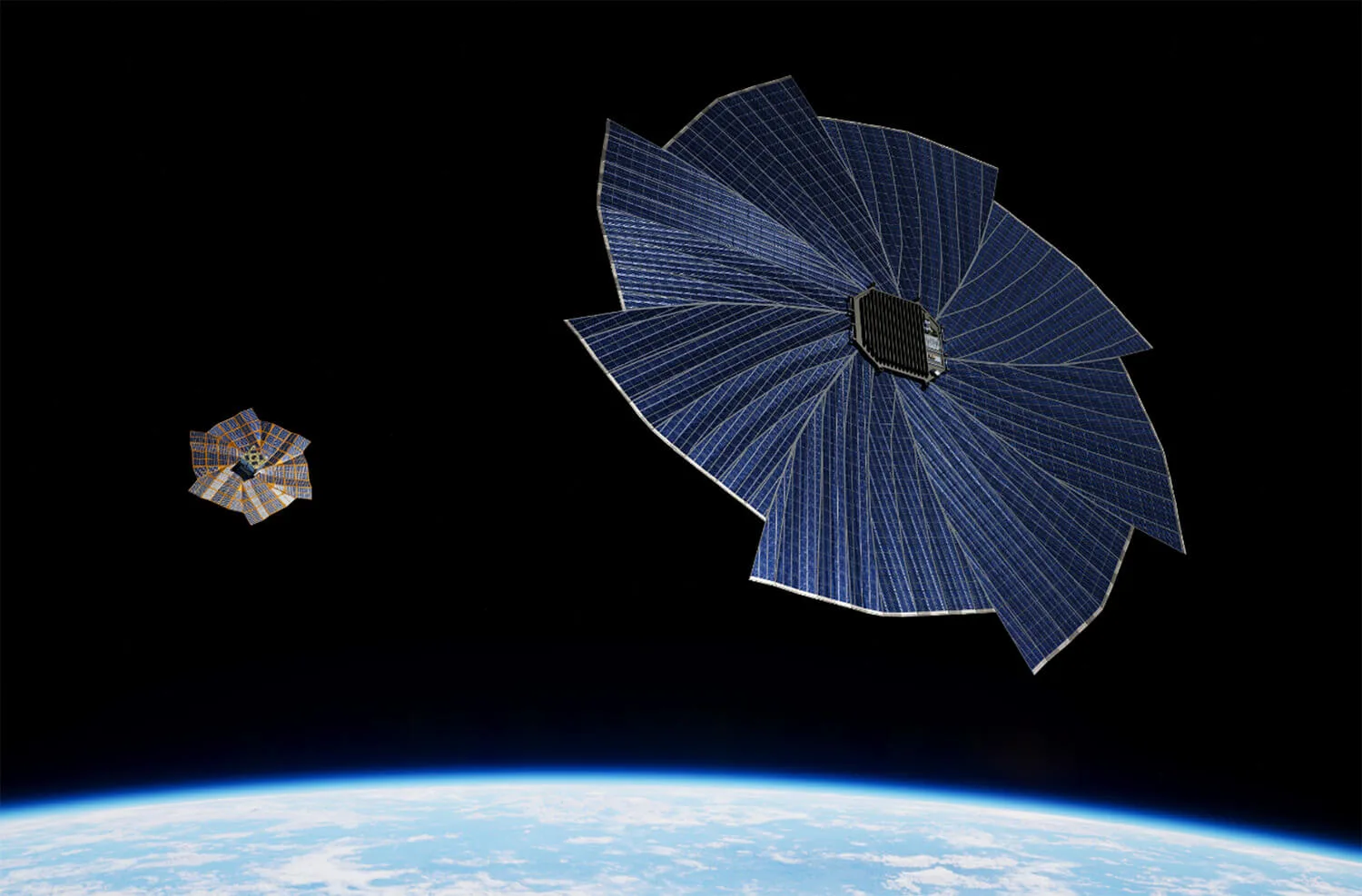
Part of the new money will bring ARAQYS, a new family of solar arrays and power systems, to market. Its first design, HALO, is a round, origami-style folding array that stows a large solar surface in a small launch volume. It uses widely available silicon cells, and Dcubed said it aims to cut the cost per watt of power in space by one to two orders of magnitude while moving from kilowatt-class systems to tens and eventually hundreds of kilowatts.
The first HALO is due to fly in 2027 on a SpaceX rideshare as part of ARAQYS-D3, a 2kW demonstration in orbit. The mission will also deploy a 10-metre boom made in space, and five power-beaming partners will take part, the company said.
What the money is for
Dcubed said the round funds two connected goals: industrialising production of its flight-proven actuators and solar arrays in Germany and the US, with the aim of quadrupling capacity, and launching ARAQYS. A large share will go to production equipment, automation, staff and supply-chain capacity.
Helen McBreen, a board member of the EIC Fund, said reliable and affordable power would be essential to the next generation of space activities and that the solar array technology Dcubed is developing could help make that possible.
Jan Szumada, an investment manager at Warsaw Equity Group, said the firm sees Dcubed as one of few European space companies that could become critical infrastructure for the global space economy, and that it would help build the organisation of a global industrial company. Christian Ziach, a principal at HTGF, noted that his fund had backed Dcubed since its seed round.
The round follows a Series A of about €4.4m that Dcubed closed in August 2024, led by Expansion and BayBG, according to Munich Startup, which cited a report in the Süddeutsche Zeitung. At that time the company also opened an office in Westminster, Colorado.
Company website: dcubed.space