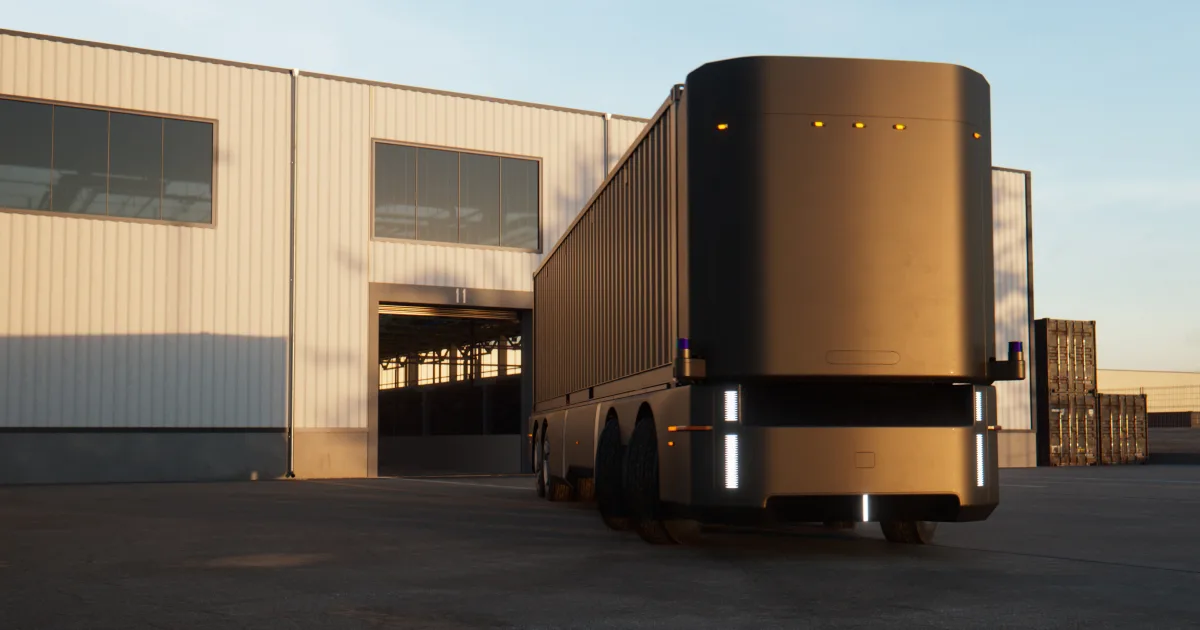
Humble Robotics, a San Francisco company building autonomous electric freight vehicles with no driver's cab, raised $51m in a Series A round, it announced on 5 November 2026.
Obvious Ventures led the round, with existing investors Eclipse and Energy Impact Partners taking part. The company did not disclose a valuation. FreightWaves reported that Humble has now raised $75m in total.
Humble said it would spend the money on customer pilots, testing and validation, early manufacturing and a wider family of vehicles built on its modular platform.
What Humble builds
The Humble Hauler is a flat, skateboard-style electric platform that does the jobs of both tractor and trailer and moves shipping containers from dock to dock. FreightWaves reported a maximum range of 200 miles, a top speed of 55 mph and a weight about 20% below a conventional tractor and trailer, and said it carries 40-foot international and 53-foot domestic containers.
Cameras, lidar and imaging radar give the vehicle a 360-degree view, and its control systems are redundant. The software uses a vision-first, end-to-end foundation model trained with photorealistic simulation, with safety limits tuned to each customer site. The vehicle charges at the depot while loaded.
The company says it designs the vehicle, the AI and the operations as one system, and works with outside AI, hardware and self-driving companies instead of building every part itself.
Why short routes
Humble is starting with regional routes of under 250 miles, which it says account for 87% of US truck tonnage, rather than long-haul highway driving. Uses listed by FreightWaves include port drayage, shuttles between plants and warehouses, rail-yard moves and short trips between a carrier's own terminals.
Chief executive Eyal Cohen told FreightWaves that short electric routes suit the technology better than long-haul, which needs large batteries and charging networks, and that a nearby depot lets engineers respond quickly if something goes wrong. Removing the cab also frees weight for cargo, which the company says lowers the cost per mile.
Humble has not named any customers. FreightWaves reported that Cohen said in August the company was aiming to start customer pilots within 12 months, and that Humble plans to sell its haulers to third-party operators.
The team and its backers
Cohen spent his early career electrifying vehicles and later worked on self-driving trucks at Apple, Otto, Uber, Pronto and Waabi, according to FreightWaves. Jiten Behl, a partner at Eclipse, told the outlet that updating freight means rethinking the whole system, from the vehicle to the software that drives it.
Humble came out of stealth with a $24m seed round led by Eclipse about six months before the Series A. Its rivals include Gatik, which runs driverless routes between distribution centres and stores and raised a $200m Series D in August, FreightWaves reported.
Company website: humblerobotics.ai