Triomics, a New York company that makes AI software for cancer centres, raised a $22m Series B, announced in late May 2026. Battery Ventures led the round. Existing investors Nexus Venture Partners, Lightspeed and Y Combinator took part, alongside two strategic backers: Oncology Ventures and Precision Health Informatics, a wholly owned subsidiary of Texas Oncology.
The round brings total funding to more than $36m. Brandon Gleklen, a principal at Battery Ventures, is joining Triomics' board. No valuation was disclosed.
“Triomics built what oncology has always needed: AI infrastructure that actually works on the full patient record.”Brandon Gleklen, Principal, Battery Ventures
What Triomics does
Triomics was founded in 2021 by Sarim Khan, its chief executive, and Hrituraj Singh, its chief technology officer. Its platform processes longitudinal cancer patient records, including notes, pathology reports, radiology findings, biomarker data and treatment histories, and turns the unstructured information into structured, explainable outputs.
HLTH reported that every recommendation the AI agents produce can be traced to its source documents within existing clinical workflows. The platform supports three main uses: matching patients to clinical trials, preparing charts before visits, and abstracting oncology data for registries, quality improvement and operations.
Oncology teams spend significant time reviewing records by hand for trial eligibility, registry reporting and care coordination, a burden the company says is growing as records and trial criteria become more complex.
Customers and results
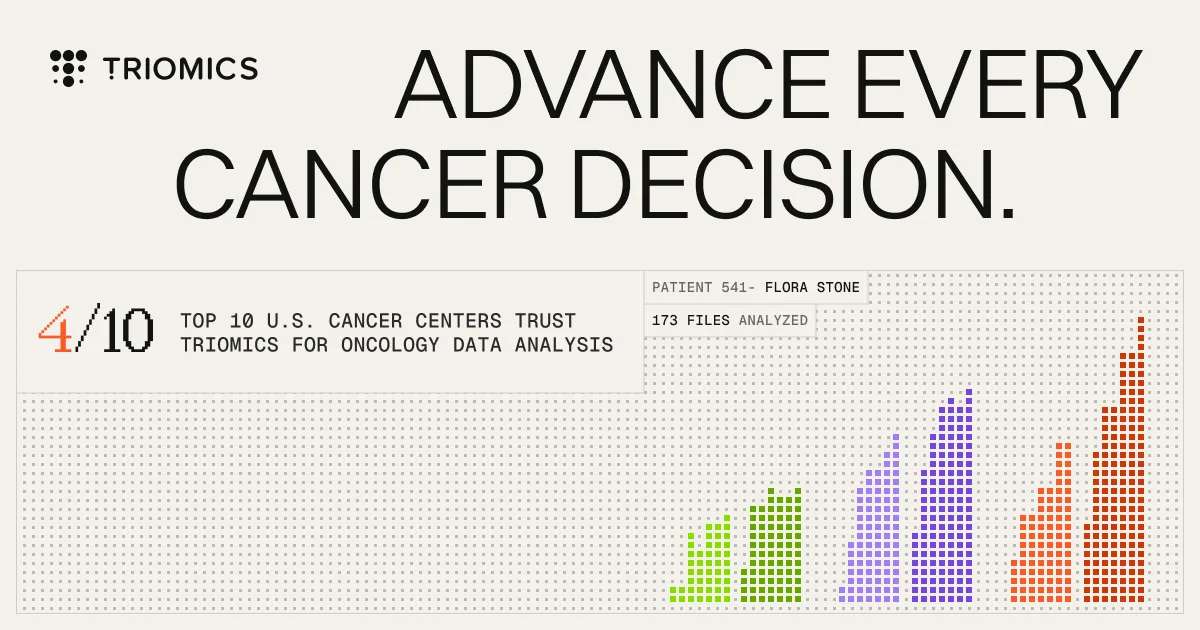
Triomics names Memorial Sloan Kettering Cancer Center, MD Anderson Cancer Center, Yale Cancer Center, Smilow Cancer Hospital, Mount Sinai Tisch Cancer Center and Texas Oncology among its customers. Its website says four of the ten top US cancer centres use it.
The company cites published results showing users raised trial matches by 40% and trial enrolment by more than 30% while cutting chart review time by 67%. It also points to peer-reviewed validation in Nature Digital Medicine and presentations at the American Society of Clinical Oncology. These outcome figures come from the company, and no independent check of them was found.
What the money is for
Triomics said the capital will speed adoption across health systems, oncology networks and life sciences organisations, expand its AI, engineering and forward-deployed teams, and advance its AI agents for clinical care and research. The company is also expanding into cancer registry abstraction and regulatory reporting.
Lee Schwamm, chief digital health officer at Yale New Haven Health System, said Yale selected Triomics for oncology clinical trial matching and wants to extend the collaboration to AI-assisted cancer registry abstraction. He said the aim is autonomous chart abstraction of registry quality that human registrars can review and finalise for mandatory reporting.
The investor view
Gleklen said Triomics built what oncology has always needed, AI infrastructure that actually works on the full patient record. He said the same underlying infrastructure already powers several workflows with no redundant integrations, and called that platform leverage rare at this stage.
Pulse 2.0 attributed a statement that oncology is the hardest place to build AI, yet the most important, to Khan, while HLTH attributed the same words to Singh, so the speaker is not named here. The reports did not give Triomics' headcount or revenue.
Company website: triomics.com