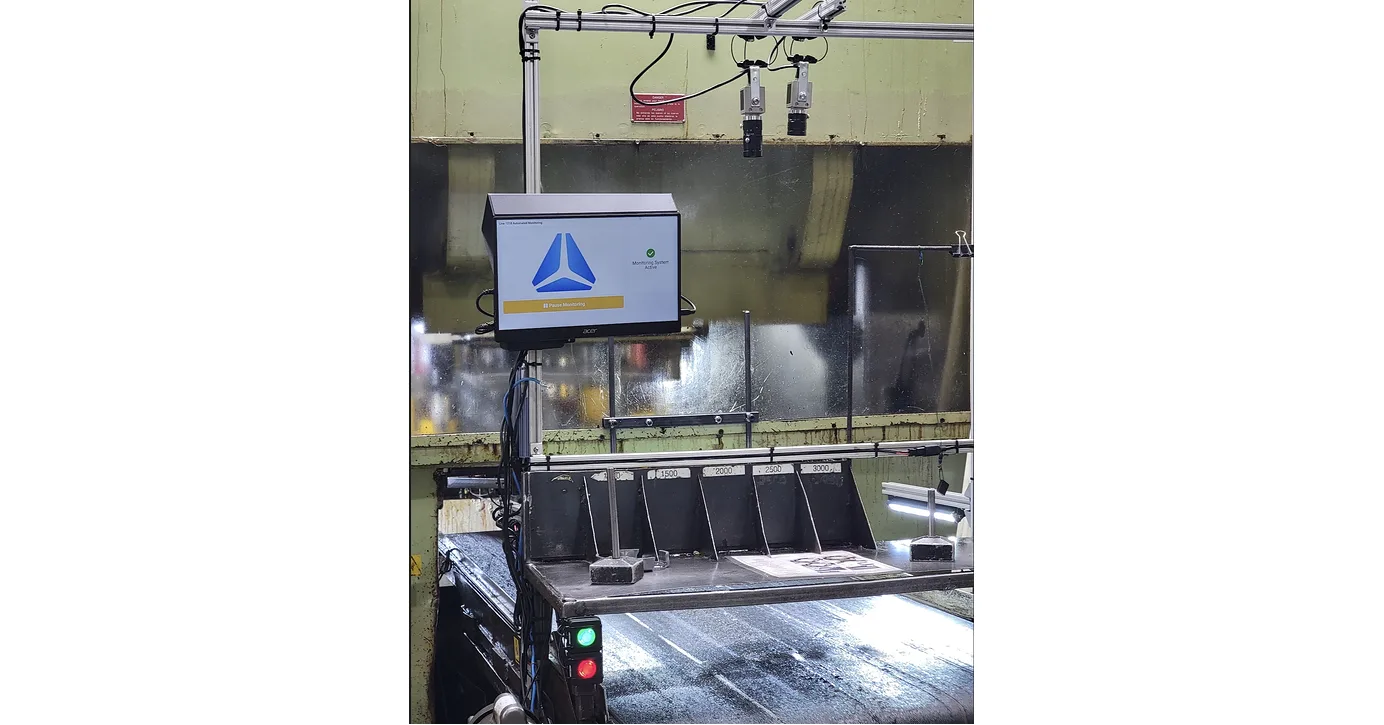
Tristar AI, a Cambridge, Massachusetts startup that uses computer vision to catch defects on factory lines, raised $12.4m in a Series A round, it announced on 12 November 2026.
Isogon Ventures led the round. Blackhorn Ventures, Ford Street Ventures, ISAI Cap Venture, Capgemini's venture fund managed by ISAI, Las Olas VC, NextView Ventures, Seraph Partners, SNR Ventures and TenOneTen also took part. The company did not disclose a valuation or how much it has raised in total.
“The problem was never that people didn't care about quality.”Salem Karani, CEO and Co-founder, Tristar AI
What Tristar AI does
Tristar's software watches materials as they move along production lines, flags defects and alerts operators within seconds. It also gives quality teams and plant managers a view across lines and sites. The system connects to cameras, sensors, programmable logic controllers and the factory and business software that plants already use.
The company focuses on automotive parts, plastic film, injection moulding and packaging. Customers named in the announcement include Amcor, Consolidated Industries, Klöckner Pentaplast and DuPont, and the company says it works with major suppliers to Toyota, Honda and Mercedes.
Tristar says it runs on more than 500 production lines in North America and Europe, that live deployments detect 95% to 99% of defects, and that customers typically recover their costs in about four months. It also reported more than fourfold growth over the past year. These figures come from the company. SiliconANGLE described the system as an alternative to manual inspection and to older machine vision tools built around fixed rules, which struggle when products or conditions change. It reported that Tristar's longer-term aim is to become the main operational record for factory floors.
The founders
Chief executive Salem Karani co-founded the company with chief product officer Jack Liu, according to Blackhorn Ventures. SiliconANGLE reported that Karani grew up helping to fix production problems at his family's plastic film plant in Houston, and studied computer vision at Harvard and MIT.
Before this round, Blackhorn led a $2.7m investment alongside existing investors, which it said was meant to prepare the company for a Series A. Blackhorn did not date that round.
What the money is for
Tristar said it would use the money to keep developing its vision and edge computing platform, move into more manufacturing sectors, build out the customer success and deployment teams that handle rollouts across several sites, and expand sales and marketing.
The company tied its pitch to the push to bring manufacturing back to the US. It cited Capgemini Research Institute figures showing that 48% of US organisations invested in reshoring in 2026, up from 30% in 2025, and that 83% see a shortage of skilled workers as a significant obstacle.
Paco Riberas, a general partner at Isogon Ventures, said Tristar made precise inspection possible, while Matthieu Eyriès of Capgemini Ventures said the investment reflected his firm's view that physical AI will play a central role in industry.
Company website: tristar.ai