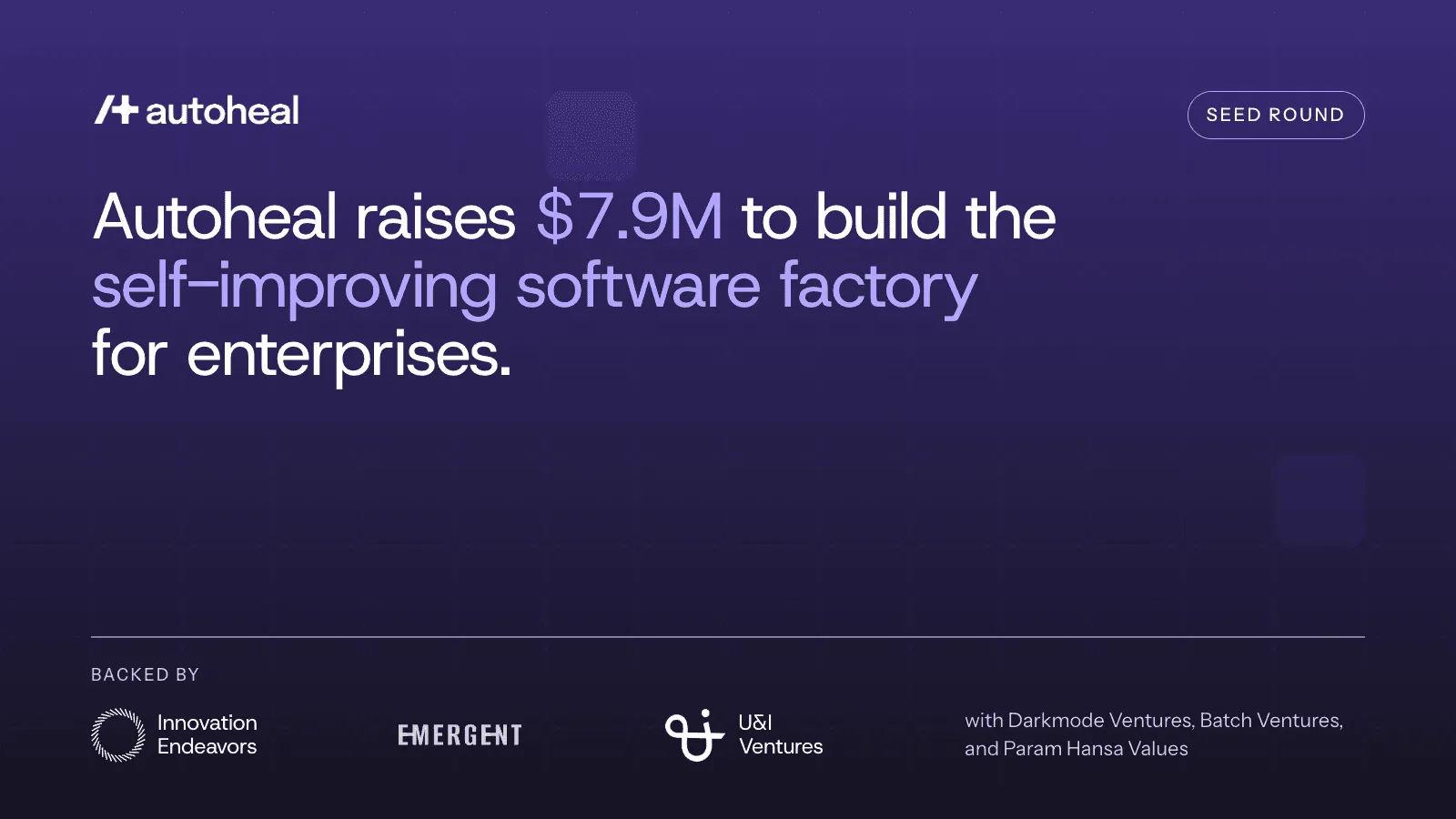
Autoheal, a start-up that builds software for running and improving AI agents inside enterprise engineering teams, said on 28 September 2026 that it had raised a $7.9m seed round.
Innovation Endeavors led the round through partner Harpinder Singh, who joined Autoheal's board, according to The SaaS News. Emergent Ventures, U&I Ventures, Darkmode Ventures, Batch Ventures (through its CTO Fund) and Param Hansa Values also took part.
The company did not disclose a valuation or say whether it had raised money before.
“In production incident response, Autoheal took our time to root cause to minutes, with evidence our engineers trust. That's time our developers stay focused on feature work. Next, we're shifting it left into other critical parts of our SDLC, because every engineering hour we get back goes into shipping faster for our customers.”Krish Shetty, CTO & SVP, AvidXchange
What Autoheal does
Autoheal calls its product a self-improving software factory. Its argument is that AI coding agents have sped up writing code, moving the bottleneck to the work after a commit: keeping software reliable, secure, cheap to run and supportable.
The platform lets engineering teams build, run and govern worker agents for three jobs: incident response and alert triage, vulnerability remediation, and keeping the cost of AI coding tools under control. It connects to a customer's code repositories, CI/CD pipelines, observability tools, cloud services, issue trackers and existing coding agents to build a shared context graph that every agent works from.
Two agents drive the improvement loop. An Evaluator scores each agent run against downstream signals such as review comments, CI re-runs and the actual root cause of an incident. A Healer turns weak scores into specific changes, such as an updated skill file or a narrower tool permission, and opens a pull request that an engineer must approve. Autoheal said the system can run in a customer's own cloud or in fully air-gapped environments.
Customers and claims
Autoheal named Nomura and AvidXchange as customers. At Nomura, its first agents handle alert triage and incident response, gathering evidence from several systems under strict access controls. AvidXchange said the product had cut the time to find the root cause of production incidents to minutes and that it planned to use it in other parts of its development process.
The company said its agents can reduce mean time to resolution by up to 80%, speed up vulnerability fixes threefold and cut AI coding costs by up to 40%. These are the company's own figures and were not independently verified. It offers a three-week proof of value measured against a customer's baseline.
Who invested
Besides the funds, several individuals invested as angels: Shawn Kung, founder of GIT100; Sumeet Arora, chief product officer of Teradata; Anshu Sharma, co-founder and chief executive of Skyflow; Savin Goyal, co-founder and chief technology officer of Outerbounds; and Srikant Gokulnatha, a former senior vice-president at ThoughtSpot.
Autoheal was founded by Sid Choudhury, its chief executive, Utkarsh Ohm, its chief technology officer, and Puneet Saraswat. The company said the team previously built and scaled the DevOps platform at Harness. The SaaS News described Autoheal as based in San Francisco; the company's own announcement did not give a location.
What the money is for
Autoheal plans to use the funding to scale its platform for building, deploying, governing and improving AI agents across the software development lifecycle, The SaaS News reported.
In its announcement, the company said its longer-term aim was for engineering teams to set targets for quality, security, reliability and cost and let governed agents work toward them. It said it was laying the groundwork for company-specific small language models trained with reinforcement learning on each customer's private development data, inside that customer's security boundary.
Company website: autoheal.ai