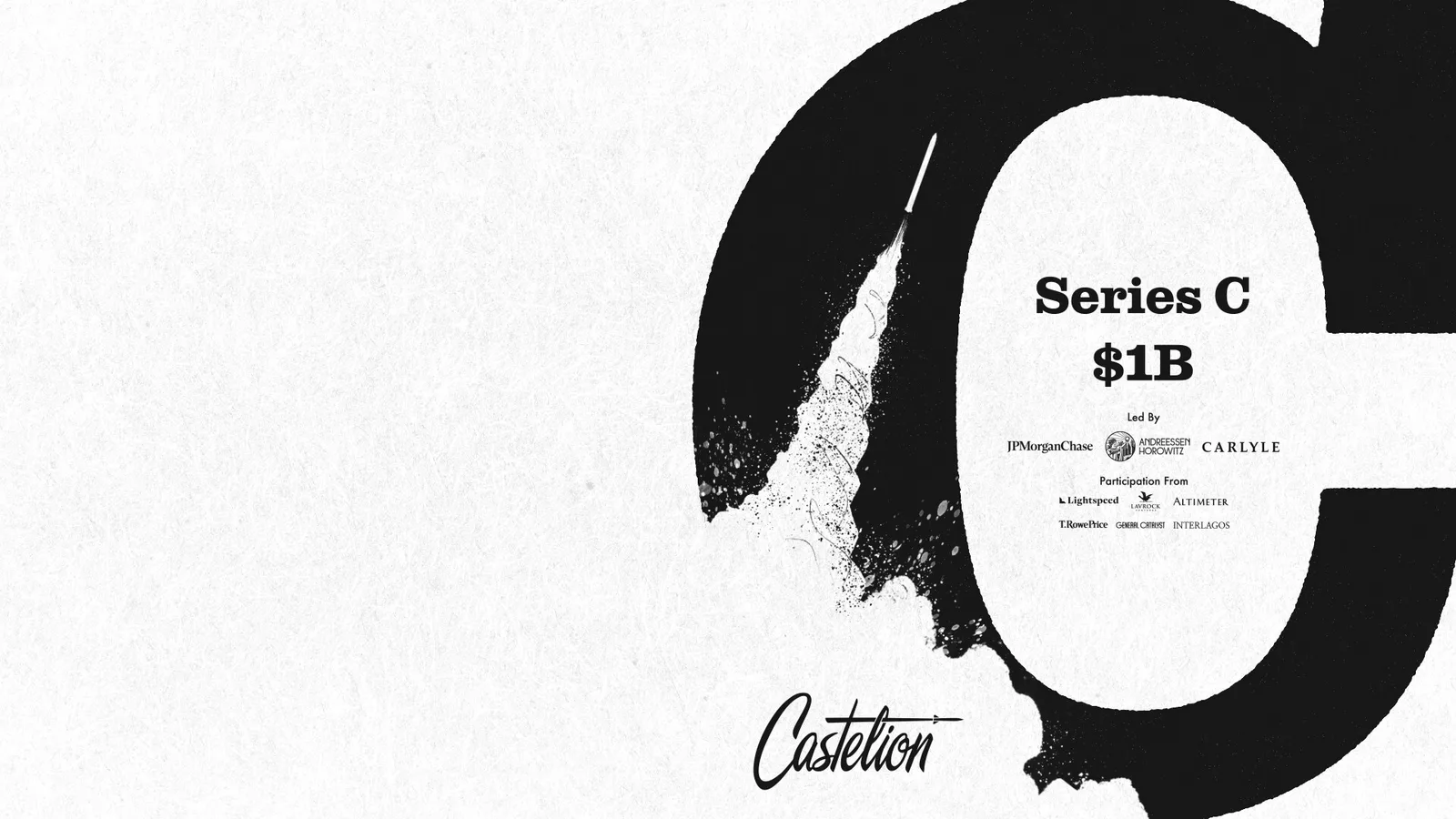
Castelion, a Torrance, California, maker of low-cost hypersonic weapons, raised $800m in Series C equity at a $13bn valuation, it announced on 19 August 2026. It also arranged a $250m committed revolving credit facility, so the company describes the total package as $1bn.
JPMorganChase's Strategic Investment Group, Andreessen Horowitz and funds managed by Carlyle co-led the equity. Lightspeed Venture Partners, Lavrock Ventures, Altimeter, General Catalyst and Interlagos returned, and T. Rowe Price joined as a new investor through an account it advises.
The money will expand production of Castelion's Blackbeard strike missile, speed work on a longer-range weapon and fund lower-cost air and missile defence systems.
“Deterrence depends on unapologetic American strength”Bryon Hargis, Co-Founder and CEO, Castelion
What Castelion does
Blackbeard is Castelion's first hypersonic strike weapon. The company was founded in 2022 by three former SpaceX executives: Bryon Hargis, who is chief executive, Andrew Kreitz and Sean Pitt, according to The Next Web.
Castelion says it has booked more than $500m in US military contracts over 18 months. The Next Web reported that in June the US Navy placed a $23.4m firm-fixed-price order for 50 pre-production Blackbeard prototypes, and that a framework agreement targets at least 500 missiles a year once testing is complete. Blackbeard fielding is targeted for 2027.
The Next Web said Castelion's Series A closed before a complete system had flown, an early bet that the round's investors now point to.
What the money is for
Castelion named three uses. The first is more capacity for Blackbeard at its Project Ranger site in Sandoval County, New Mexico, where it has already committed more than $250m of its own capital and expects to commit hundreds of millions more. The second is accelerated development and testing of a longer-range precision strike weapon that shares technology with Blackbeard. The third is lower-cost air and missile defence systems built on the same technology.
The Next Web described Project Ranger as a 1,000-acre campus.
Who invested
Todd Combs, head of JPMorganChase's Strategic Investment Group, said Castelion is helping to address a critical national security challenge. Katherine Boyle, a general partner at Andreessen Horowitz, said the firm backed Castelion when it was a small team that wanted to build what the Department of War most needed.
Ravi Mhatre, co-founder of Lightspeed, said very few teams convert capital into physical capability at that ratio.
The funding so far
Castelion's Series B was $350m, announced on 5 December 2025 and led by Altimeter Capital and Lightspeed Venture Partners. Lightspeed also led the Series A, which closed before a complete system had flown, and Lavrock Ventures backed the pre-seed round. The sources do not give those earlier amounts.
Hargis said in the announcement that deterrence depends on unapologetic American strength. The company did not disclose its headcount.
Emma Norchet of T. Rowe Price pointed to contracts in hand, a manufacturing campus built with the company's own capital, and unit economics that improve with scale. Aaron Hurwitz of Carlyle's aerospace, defence and government team called Castelion a critical asset to national security.
Company website: castelion.com