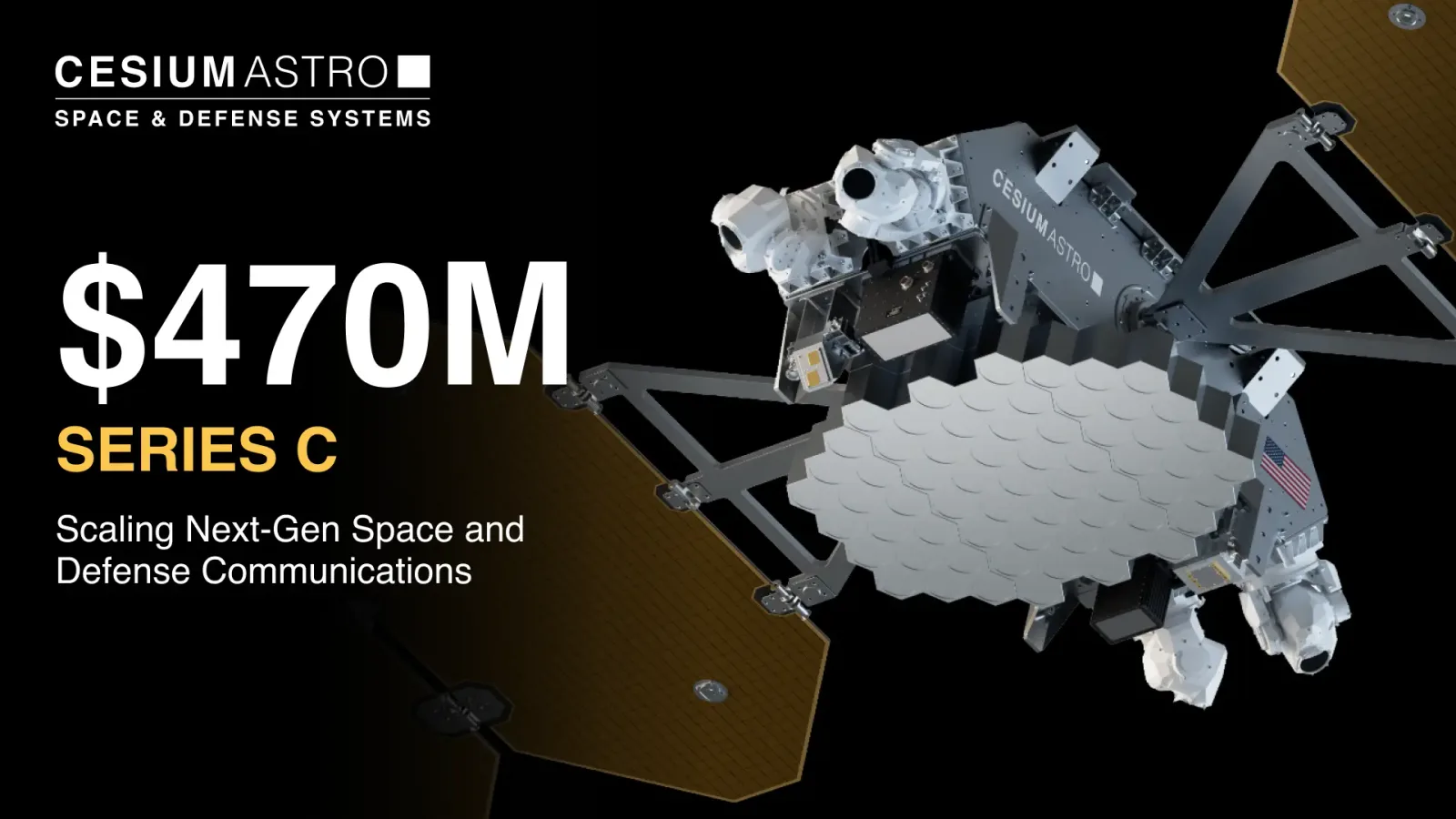
CesiumAstro, an Austin company that makes communications systems and satellites for space and defence customers, announced a $470m Series C on 2 February 2026. The round combines $270m of equity led by Trousdale Ventures with a $200m financing package from the Export-Import Bank of the United States and J.P. Morgan, under EXIM's Make More In America initiative.
Only the equity portion is counted as the round on this site. The company's CFO described the financing package as non-dilutive, but the sources do not specify its structure. SiliconANGLE referred to it as debt. No valuation was disclosed.
“This is a scale moment. Our technology is moving from breakthrough to American Industrial backbone.”Shey Sabripour, Founder and CEO, CesiumAstro
Who invested
Woven Capital, Janus Henderson Investors, Airbus Ventures, the Development Bank of Japan, MESH, EDBI and NewSpace Capital joined the equity round, together with other unnamed global investors, according to the company's release.
Phillip Sarofim, founder of Trousdale Ventures, said the firm backed engineering excellence with the discipline to deliver hardware over hype. Chief financial officer Ken Smith said the funding validates the company's progress and accelerates its next phase of growth, and that the raise reflects broad confidence in its execution across commercial and defence markets.
Pulse 2.0 reported that Sarofim pointed to the company securing eight SpaceX rideshare launches over the past year. Will Fung, a principal at Woven Capital, said the company is moving away from rigid, legacy hardware toward a modular, software-defined approach. The release described the $200m package as a first-of-its-kind public-private partnership.
What CesiumAstro does
The company's website describes spacecraft and space payloads, satellite terminals, processors and software-defined radios. Its fully integrated low-Earth-orbit satellite is called Element. SiliconANGLE listed other products: the RDP-23FV chip with multiple Arm-based processors for onboard software, the RPU that orchestrates antennas and supports beamforming, the SDR-2104 software-defined radio with an FPGA for AI applications, and Skylark, a phased-array terminal for connecting to constellations from cars, ships and aircraft.
SiliconANGLE said Element operates at altitudes of 310 to 635 miles and is designed to work for five years. It also reported that the company is launching more than half a dozen satellites in the coming years, a plan the company's release did not detail.
Shey Sabripour is the founder and chief executive. Neither source gives a founding year or a headcount.
What the money is for
CesiumAstro said it will build a new 270,000-square-foot headquarters in west Austin, expand manufacturing capacity, scale production of Element, deploy its AI-enabled space communications platforms globally and grow its technical and programme teams. It has facilities in Colorado, California, the UK, Germany and Japan.
Sabripour said: "This is a scale moment." Built In quoted him saying the funding lets the company deliver resilient, AI-enabled communications to connect, detect and defend at global scale, faster.
Company website: cesiumastro.com