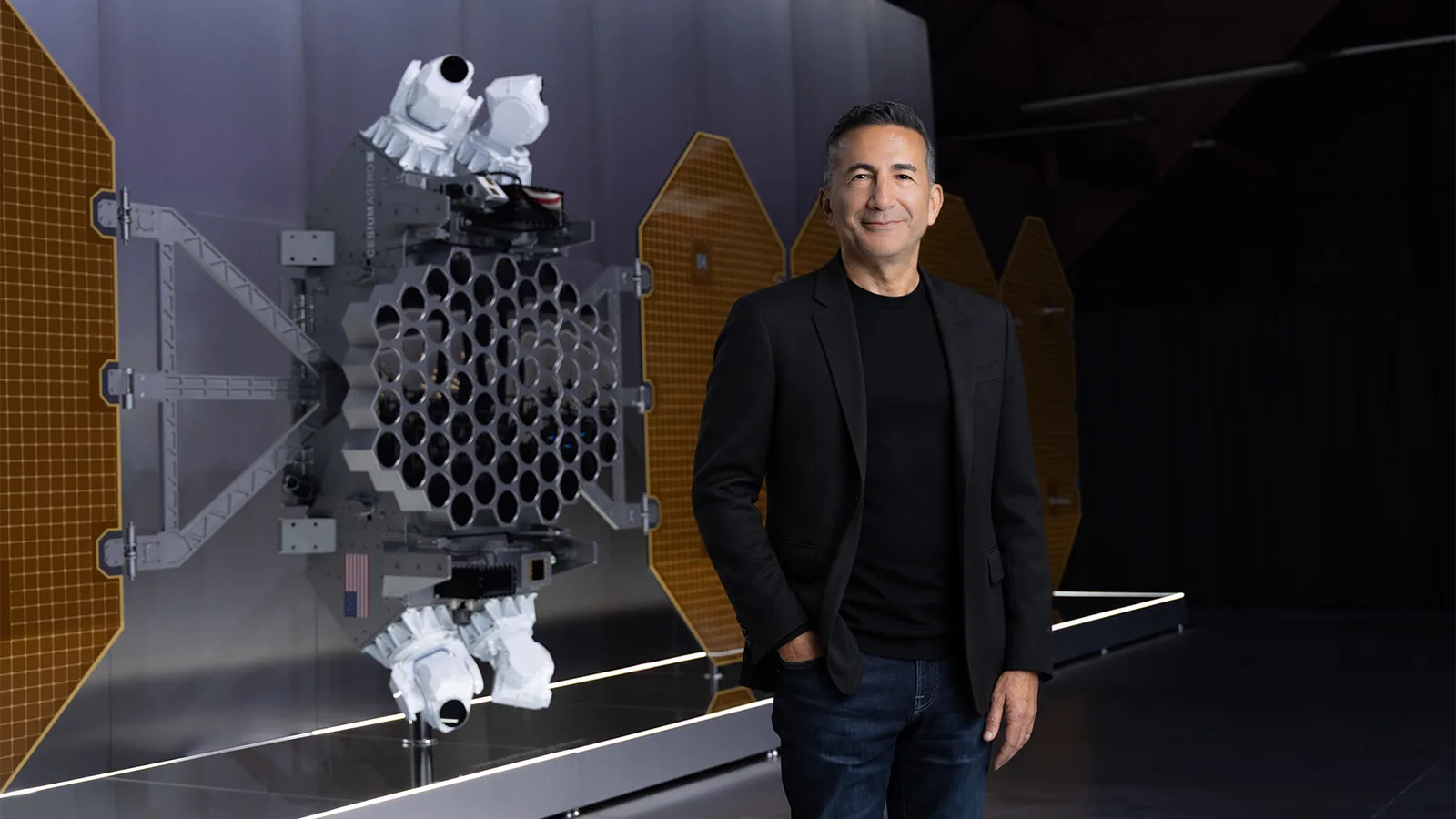
CesiumAstro, an Austin company that builds satellites and communications payloads, raised $730m in a Series D round at a valuation of more than $4.5bn, it announced on 5 November 2026.
Janus Henderson led the round. Insight Partners, Sands Capital, Sumitomo Corporation of Americas, Woven Capital (Toyota's growth fund), Incharge Capital, Magnetar, AV and NewSpace Capital also invested.
The total includes $100m of debt from the Export-Import Bank of the United States (EXIM) and JPMorgan. The company did not break out the split, but Payload reported that the equity portion is $630m, the figure used on this site's tracker.
“We designed the silicon, the active phased array, the payload, processors, the spacecraft”Shey Sabripour, Founder and CEO, CesiumAstro
What CesiumAstro builds
CesiumAstro designs most of the hardware in its spacecraft itself, from chips to active phased-array antennas, which steer radio beams electronically. "We designed the silicon, the active phased array, the payload, processors, the spacecraft," founder and chief executive Shey Sabripour said.
Its first spacecraft, Element-1, launched in October 2026 on a SpaceX rideshare mission, according to The Next Web and Payload. It is the first of eight planned spacecraft, and launches for the other seven have been secured.
The company is now planning Synchronicity, a constellation of 737 satellites using Ku-, Ka- and V-band radio, with computing on board and operations across several orbits. Payload reported a goal of 350 satellites in orbit by 2032. Sabripour told Bloomberg, as quoted by The Next Web, that customers "don't want to be part of a proprietary system", though they are not necessarily competing with Starlink.
Element-1 flew on SpaceX's Transporter-18 mission aboard a Falcon 9 rocket, and Payload reported that the remaining seven spacecraft are due to launch in 2028 and 2029. The company describes its technology as the result of nearly a decade of investment.
What the money is for
CesiumAstro said the funding will go into new technology, more US manufacturing, next-generation spacecraft, the Synchronicity build-out and international growth. The Next Web and Payload reported a plan to spend $500m over five years on its Austin site, including 270,000 sq ft of manufacturing space.
The company plans 550 new jobs and expects its Austin-area workforce to pass 1,000 people by 2030. It has also been buying companies: The Next Web and Payload listed Jariet Technologies, 1Aardvark and Vidrovr as acquisitions in the past year.
Aaron Schaechterle, a portfolio manager at Janus Henderson, said that "legacy solutions are not equipped for the demands of today's customers".
The funding so far
The Series D comes nine months after a $470m Series C in February 2026, which combined $270m of equity led by Trousdale Ventures with a $200m EXIM and J.P. Morgan financing package.
CesiumAstro said it has announced more than $1.2bn of capital in 2026. The Next Web, citing Bloomberg, put its total funding at $1.4bn.
The investor list mixes asset managers such as Janus Henderson and Sands Capital with corporate backers, including the US arm of Sumitomo and Toyota's growth fund, Woven Capital. The company did not say how many people it currently employs.
Company website: cesiumastro.com