Endeem, a Seattle company that makes security software for AI agents used inside businesses, came out of stealth on 17 November 2026 with a $2.5m pre-seed round.
Beta Boom and Auriga Cyber Ventures co-led the round, which the company said was oversubscribed. Treeo VC and strategic angel investors also took part.
Endeem did not disclose a valuation, founding date or headcount, or say how much each investor put in. Its platform is now generally available.
“When a company hires someone, nobody hands them a colleague’s password, yet that is how most AI agents work today.”Yannick Pobiega, founder and CEO, Endeem
The problem Endeem is tackling
According to Endeem, most AI agents in companies run on an employee's credentials, so they can do anything that employee is allowed to do. Logs cannot separate the agent's actions from the person's, and costs are hard to assign to a team or a task, which makes it difficult to judge whether the spending pays off. In practice, a security team reviewing the records cannot tell whether a change was made by a member of staff or by an agent working on that person's behalf.
The company says businesses often respond by blocking agents altogether or by requiring approval for every step, which slows adoption. Founder and chief executive Yannick Pobiega compared agents with new staff, who get their own login, access to what the job requires and someone to check with on important decisions, and said Endeem is meant to let companies admit agents in the same way.
How the product works
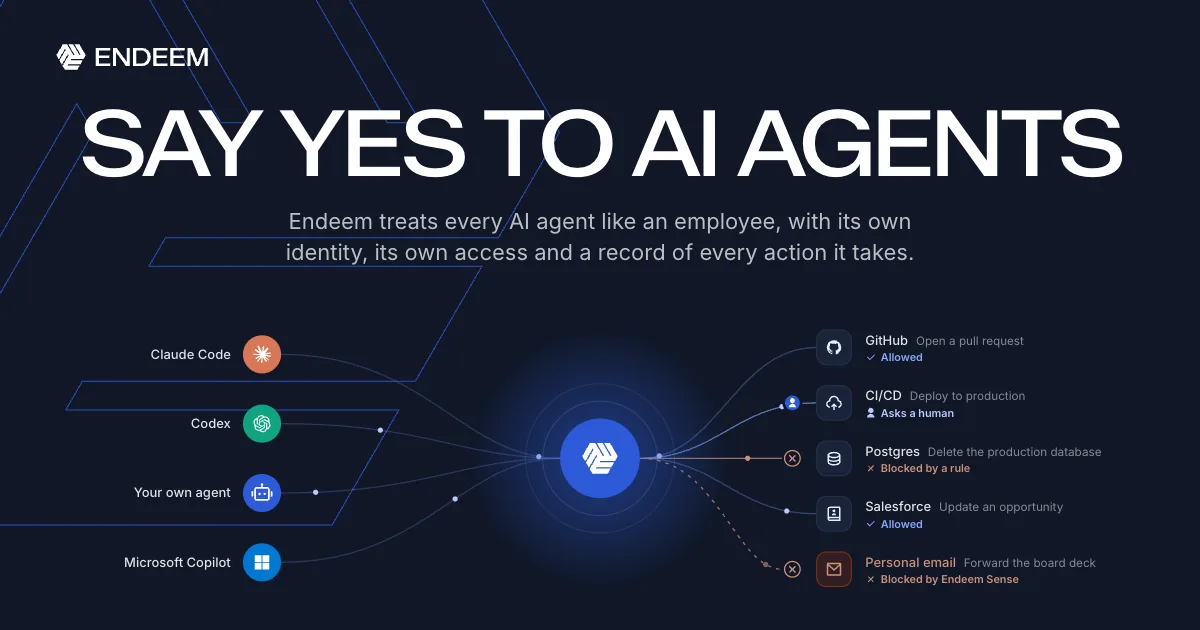
Citybiz described the product as an enterprise AI security platform for monitoring and controlling AI agents. Endeem gives each agent an identity separate from the employees who use it, and records what the agent does, who prompted it and what it costs. It also shows so-called shadow AI, meaning agent use that the company has not approved.
Each request is checked against company security policies, whether it goes through an API, a Model Context Protocol (MCP) connection or a command-line tool. Administrators can let routine actions through, require a person to approve sensitive ones and block those that are not permitted. In one example the company gives, an agent can read a database but not delete anything from it. Instead of permanent credentials, the system issues short-lived ones for each request.
The software runs on employee laptops and in the cloud and does not require changes to existing agents. It supports Claude Code, OpenAI Codex, Claude Cowork, Microsoft Copilot and agents that companies build themselves.
Pilots and plans
Endeem is running pilots with several companies in pharmaceuticals, financial services and software, including one of the 20 largest pharmaceutical companies in the world. Citybiz noted that it has not named customers or disclosed commercial figures.
Kimmy Paluch, managing partner at Beta Boom, said the need to control agent access and keep an auditable record of what agents do was growing quickly. She also described Pobiega as a driven and resourceful founder.
The company said it will use the funding to speed up product development and expand adoption among large companies.
Company website: endeem.ai