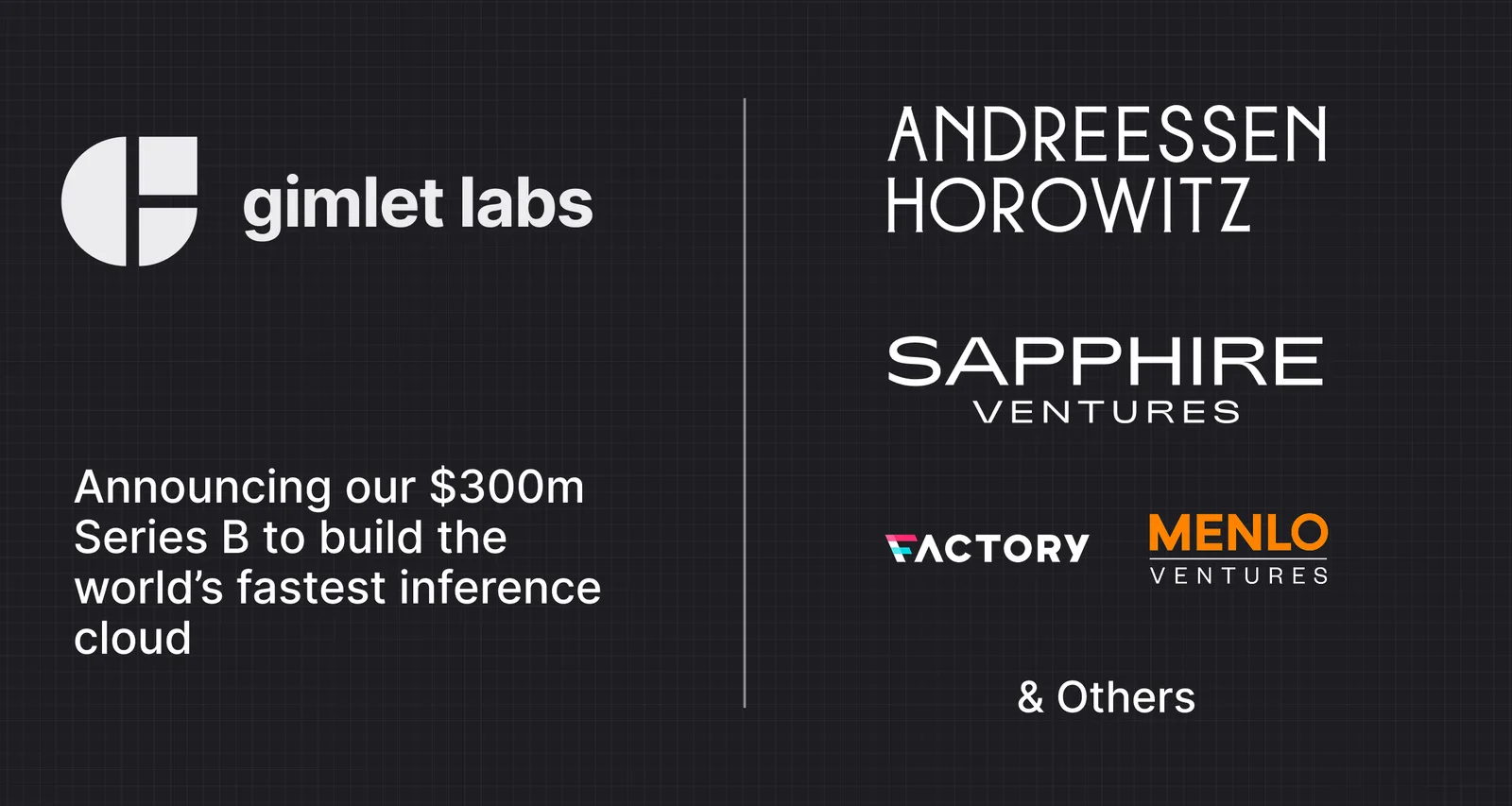
Gimlet Labs, a San Francisco start-up that runs AI inference across several kinds of chips, announced a $300m Series B on 4 September 2026. Andreessen Horowitz led the round.
The round brought the company's valuation to $3bn, Bloomberg reported. Gimlet's own announcement did not mention a valuation.
Sapphire Ventures, Menlo Ventures, 645 Ventures, Arm, Eclipse, Emergence, Factory, Hudson River Trading, M12, OnePrime Capital, Prosperity7, QuantumLight, Samsung Ventures, Tiger Global Management, Triatomic, Wing Ventures and XTX Markets also took part.
What Gimlet Labs does
Gimlet is building what it calls a multi-silicon cloud for AI inference, meaning the work of running trained models. Its software breaks a model into parts and runs each stage on the type of chip best suited to it, mixing GPUs, CPUs, dataflow processors and near-memory compute.
The company says this approach gives speedups of five to ten times for the same power use, and three to ten times faster performance on frontier workloads in its cloud. According to Yellow, the platform routes work across chips from six makers: Nvidia, AMD, Intel, Arm, Cerebras and d-Matrix.
Gimlet said it works with frontier AI labs and other large users of inference. It said that since March it had added billions of dollars in contracted revenue and gigawatts of data-centre pipeline, and was scaling towards hundreds of megawatts of managed capacity. It did not disclose revenue or name customers.
Chief executive Zain Asgar founded the company in 2023, according to ValueAdd VC, which also put the team at roughly 30 people. The other authors of the funding announcement were Michelle Nguyen, Omid Azizi, James Bartlett and Natalie Serrino.
Who invested
Arm and M12, Microsoft's venture fund, are new investors, Asgar told Bloomberg. He said Gimlet was also working with Arm to make its software run on different forms of Arm's chip technology.
Menlo Ventures and Factory were existing backers, according to ValueAdd VC.
Why inference hardware matters
In its announcement, Gimlet argued that demand for inference is growing faster than the power available to serve it. It said monthly token generation had risen six times in 12 months and that AI data centres used about 18 GW of capacity in 2025, a figure expected to triple by 2030.
The company said customers increasingly need both high throughput and fast responses, driven by AI agents that make dozens of model calls in a row, models that have grown to between 3 and 10 trillion parameters, and context windows that can now reach a million tokens. It argued that infrastructure built from one type of chip forces a trade-off between those two goals, and that more output per kilowatt is what will let the industry keep growing.
The funding so far
The Series B came just over five months after Gimlet's Series A, according to the company. Bloomberg and ValueAdd VC put that earlier round at $80m. ValueAdd VC reported total funding of $392m including the new round.
Gimlet said it would use the money to add inference capacity for more customers and to hire researchers, engineers and operators across its infrastructure stack.
Company website: gimletlabs.ai