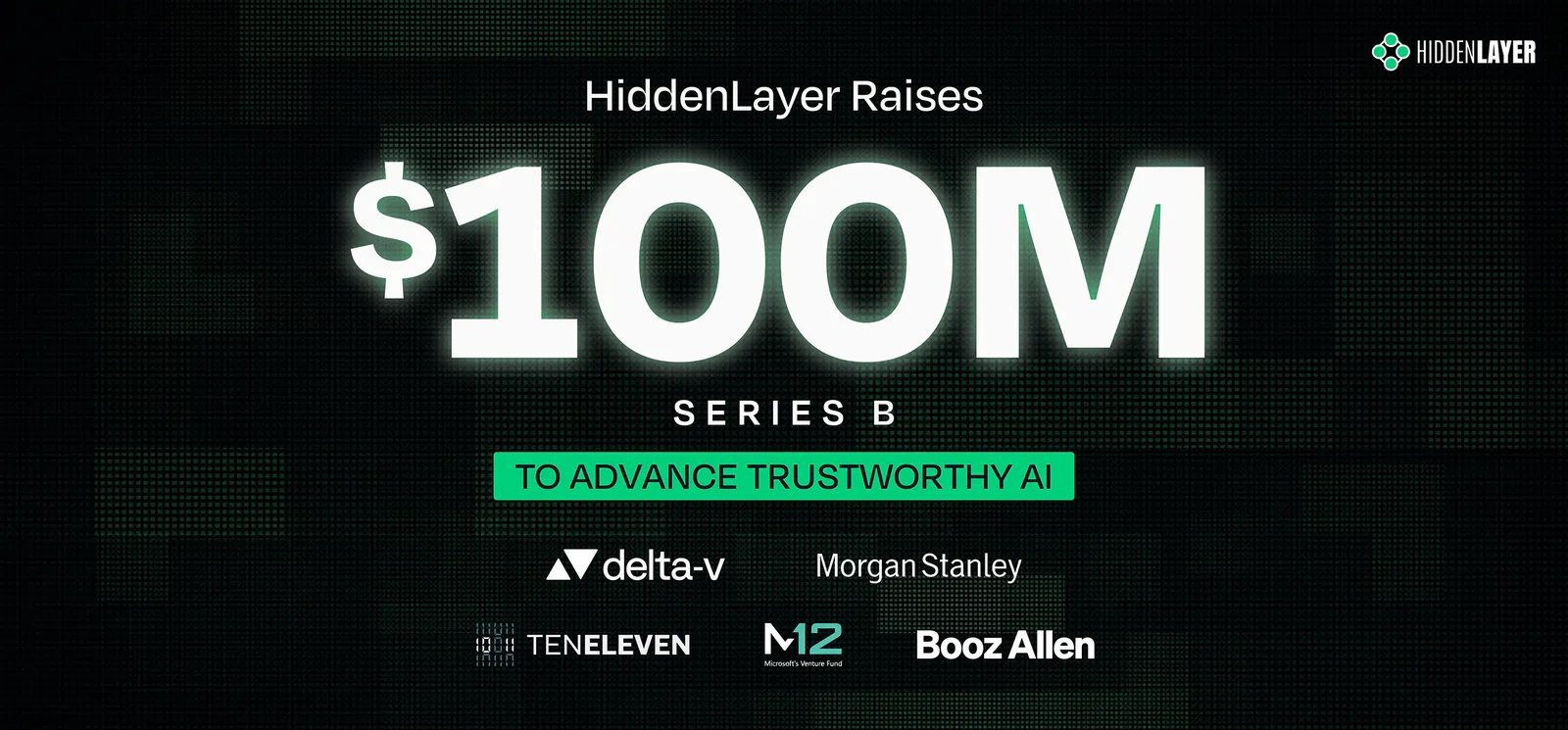
HiddenLayer, an Austin-based company that sells security software for AI systems, raised $100m in a Series B round led by Delta-v Capital, it announced on 2 September 2026. Ten Eleven Ventures, Morgan Stanley, M12 (Microsoft's venture fund) and Booz Allen Ventures also took part.
The round brought HiddenLayer's total funding to more than $155m, according to SecurityWeek. The company did not disclose a valuation.
HiddenLayer said it would use the money to expand its enterprise platform, in particular its agentic runtime security features and Agent Harness Security, a new product that protects AI coding agents while they run. It also plans to hire, deepen channel partnerships and expand internationally, starting with Europe and the wider EMEA region.
“We set out to pioneer trusted, secure use of AI for enterprises, long before most organizations saw the urgency we do today. This funding lets us keep growing the purpose-built team and platform required to meet that moment as agentic AI becomes core to how enterprises operate.”Chris Sestito, CEO and Co-Founder, HiddenLayer
What HiddenLayer does
HiddenLayer's platform covers agentic, generative and predictive AI across its lifecycle. Its modules discover AI assets in use across a company, check models and their supply chain before deployment, run simulated attacks to find weaknesses, and detect and block attacks in production.
The company said the new money would focus on two areas where it sees enterprises as most exposed: giving organisations visibility into how AI agents behave in production, so that manipulation, tool misuse and unauthorised actions can be stopped as they happen, and securing autonomous coding agents that write, review and ship code with far less human oversight than traditional development tools.
HiddenLayer cited its own 2026 AI Threat Landscape Report, which found that 96% of organisations consider AI critical to their core operations, while nearly a third could not say for certain whether they had suffered an AI-related breach.
Growth and research
HiddenLayer said its annual recurring revenue grew more than ten times over the past year and that it signed more than 50 new platform customers. It listed customers in securities brokerage, banking, insurance, accounting, government, technology, IT services, pharmaceuticals, airlines and the US defence and intelligence communities, without naming them. Abroad, it added one of the world's largest pharmaceutical companies, several premium car brands and food and beverage firms.
The company also said it helps a leading frontier model provider secure more than 700 million weekly users. Its researchers hold 39 granted patents and 65 pending patents, and it works with organisations including CISA, MITRE, NIST, OWASP and OpenSSF.
HiddenLayer recently appointed Mike Gesnaldo as chief revenue officer and said more hires would follow. It did not give a headcount.
Who invested
Delta-v Capital, which describes itself as a sector-focused growth investor managing more than $1.6bn, led the round. Partner Dan Williams said traditional security tools were built for code and infrastructure, "not for models that can be poisoned, hijacked, or manipulated through their own inputs".
Mark Hatfield, co-founder and partner at Ten Eleven Ventures, said enterprises do not shift budgets this quickly unless a problem is urgent. Zheng Wang, head of strategic investments at Morgan Stanley, said HiddenLayer had been early to recognise that security is critical to the safe deployment of AI.
HiddenLayer was founded in 2022, according to SecurityWeek, and is led by co-founder and chief executive Chris Sestito. The company did not detail its earlier funding rounds in its announcement.
Company website: hiddenlayer.com