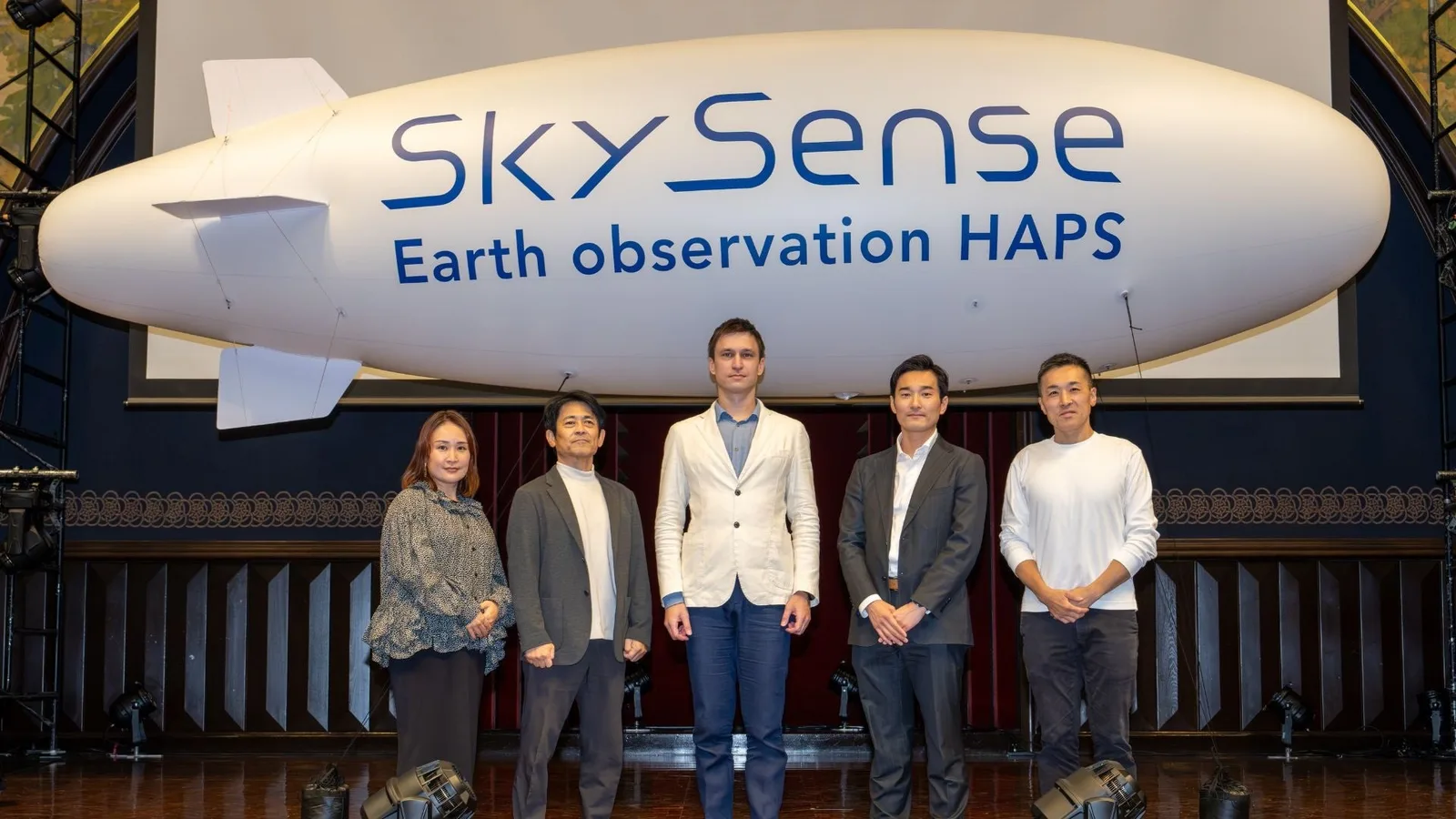
SkySense, a Tokyo startup developing airships designed to stay in the stratosphere and watch the ground below, raised ¥150m (about $0.94m) in a seed round, it announced on 12 November 2026.
Archetype Ventures led the round. Midtown Frontier Fund and the Toyama Co-Accel Fund, a deep-tech fund managed by the Tokyo company Relic, also invested. The money came in through J-KISS stock acquisition rights, a convertible instrument rather than a priced share sale, and no valuation was disclosed.
SkySense was founded in January 2024 as a spinout from the Tokyo Institute of Technology and is based in Minato, Tokyo.
What SkySense is building
The company works on high-altitude platform stations, or HAPS: aircraft that fly in the stratosphere for long periods. Its version is an airship based on technology from JAXA, Japan's space agency. Relic said the design draws on JAXA's earlier stratospheric platform project.
SkySense says observation satellites pass over any given spot only occasionally and often lack resolution, while aerial photography is sharp but covers small areas at high cost. An airship that stays over one area at about 20km could, in its plan, collect images at a resolution of 10cm or better with a positional accuracy of around 1m, and keep doing so continuously.
Relic said a test with a tethered balloon in January 2025 produced images at 8cm ground resolution and showed that night-time observation worked. It added that the airship needs no runway and should cost less to build and run than fixed-wing designs. SkySense lists disaster response, security, infrastructure monitoring and agriculture as its target uses.
Who invested
A partner at Archetype Ventures said Japan was ahead in stratospheric platform research in the 2000s, but the work stopped because batteries and materials were not good enough, leaving a gap of about 20 years. He said SkySense is picking that work back up with current batteries, materials, control systems and AI.
Relic's fund, which made its first close on 30 June 2026 with Hokuriku Bank as lead backer, invests in research from universities in Japan's Hokuriku region. Relic linked the investment to the January 2024 Noto Peninsula earthquake, when broken roads made it hard to see the extent of the damage in the first days. It said it will help SkySense find customers among local governments and companies in the region.
What the money is for
SkySense will put the money into a flight test, planned for March 2027, in which a small prototype airship will fly and observe a fixed point. It will also develop the airframe and observation equipment, build a system to deliver its data, and hire engineers; it is recruiting a candidate for chief technology officer and an airship design engineer.
The company plans demonstration operations in the second half of 2027 and a commercial service by the end of the 2029 financial year. Before this round it ran an Earth observation trial through KDDI's MUGENLABO UNIVERSE programme and was selected for the ICT Startup League and for a NEDO startup support programme.
Its chief executive, who has a background in robotics, said he started SkySense because he had long liked airships and wanted to bring them back into use.
Company website: sky-sense.jp