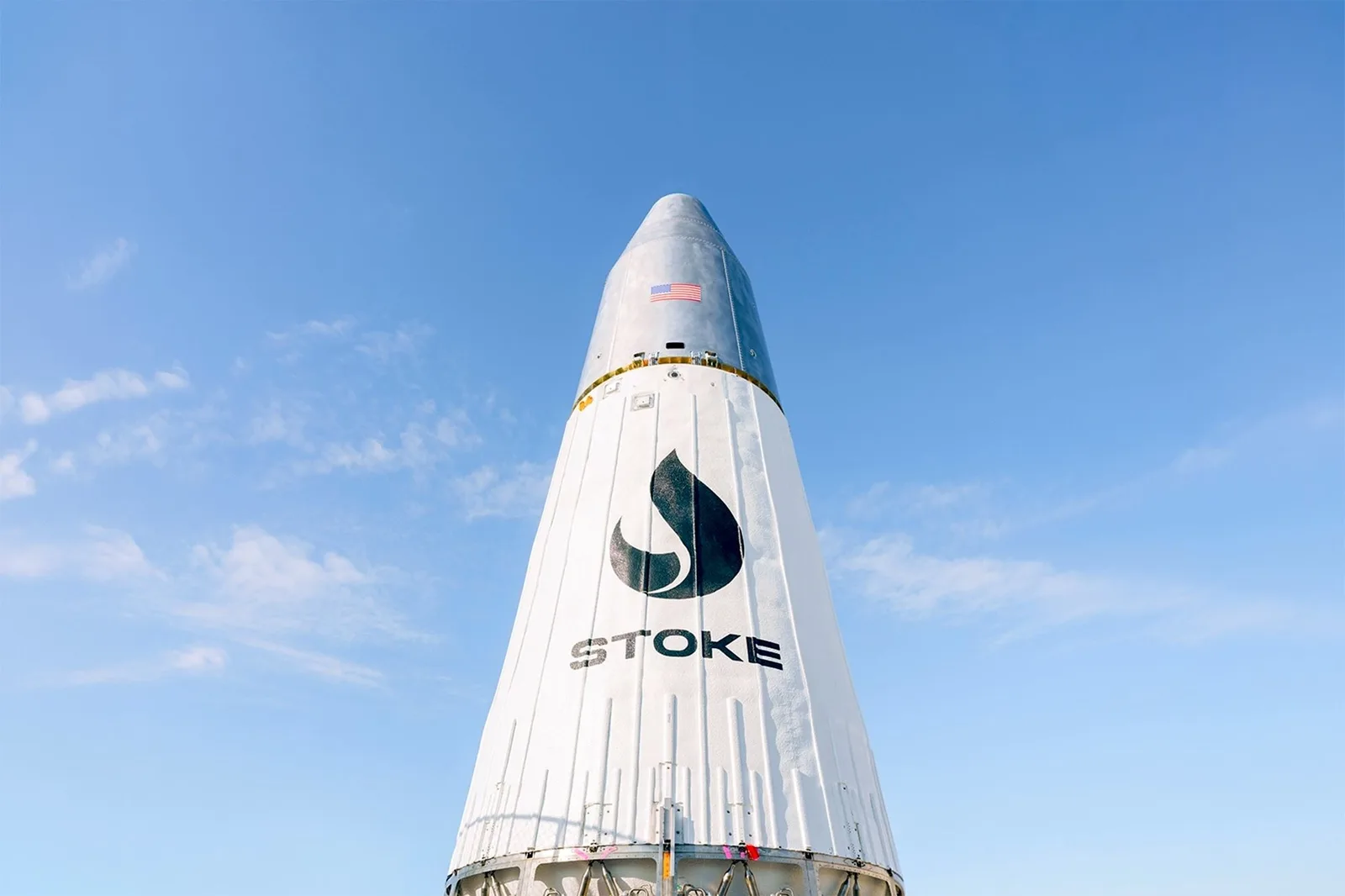
Stoke Space, a launch company in Kent, Washington, announced on 8 September 2026 the initial close of a $1bn Series E round. The company said the raise brings its total funding to $2.3bn.
Point72 Ventures and Spark Capital co-led the round. General Innovation, Glade Brook Capital, US Innovation Technology, Washington Harbour Partners, Woven Capital and Y Combinator also took part, alongside other new and existing investors that the company did not name. Stoke did not disclose a valuation.
The Next Web noted that the announcement described an initial closing of a billion-dollar round, so the amount received at this stage was not disclosed separately.
“This investment enables us to scale toward delivering the capability and cadence our customers require.”Andy Lapsa, Co-founder and CEO, Stoke Space
What Stoke Space does
Stoke is developing Nova, a launch vehicle designed so that both of its stages can be recovered and flown again. Co-founder and chief executive Andy Lapsa argued that every mature transport system is built around fully reusable vehicles and that this is the only way to bring launch costs down while increasing availability.
Its first vehicle, Nova Pathfinder, is approaching its first flight. Stoke said Pathfinder will carry payloads to orbit while proving the rocket's core architecture and reuse technology. Its first orbital launch is targeted for early 2027.
A larger version, Nova Block 2, is being built on Pathfinder's design. Stoke said it will carry 15 metric tons to low Earth orbit inside a 5-metre payload fairing, with a first launch targeted for 2029. The company has received support for its technology development from NASA, the US Space Force, the Defense Innovation Unit and the National Science Foundation.
Who invested
Point72 Ventures said it had backed Stoke through several earlier stages. Chris Morales, a partner at the firm, said Stoke was pursuing what Point72 sees as one of the most important opportunities in space transportation, and that the company had shown strong technical progress.
Clay Fisher, general partner at Spark Capital, said full reusability is the inevitable end state of the launch market. He said Stoke had the right thesis seven years ago and had combined it with fast execution.
The Next Web pointed out that the round was raised for a rocket that has not yet flown, and that Y Combinator, an early-stage investor, was among the participants.
What the money is for
Stoke said the capital will go into its core reuse technologies and into the manufacturing, test, launch and recovery infrastructure needed for frequent flights. It will also prepare Nova Pathfinder for its first orbital launch, expand production and launch capacity, and speed up development of Nova Block 2.
Lapsa said Pathfinder is meant to let the company learn quickly, reduce risk and prove the hardest parts of a fully reusable design in flight, while Block 2 scales those lessons up to the capacity customers want.
Stoke did not give details of its earlier rounds in the announcement. Based on its stated totals, about $1.3bn had been raised before this Series E.
Company website: stokespace.com