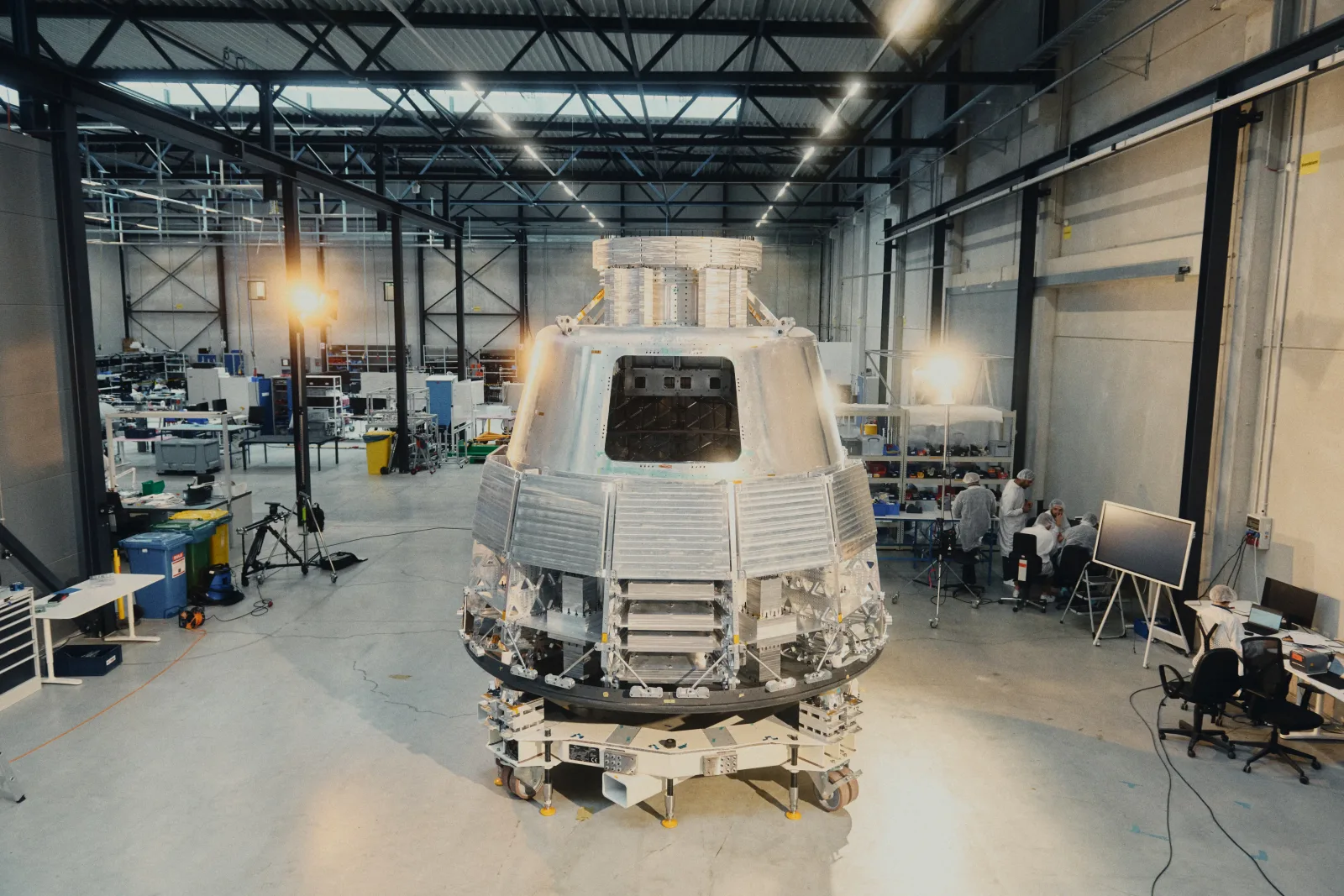
The Exploration Company (TEC), a European space company building a reusable cargo capsule and a high-thrust rocket engine, raised $450m (about €387m) in a Series C round announced in Paris on September 8, 2026.
Bessemer Venture Partners, Atomico and the Scaleup Europe Fund, which is managed by EQT, co-led the round. Existing European investors Balderton, Plural, Cherry Ventures and Red River West also took part, and the company said new US and European investors joined. TEC did not disclose its valuation.
The company said it was the largest Series C ever announced by a European space company, and the largest round raised by an EU-headquartered company led by a female founder and chief executive. The financing brings TEC's total funding to about $680m and is subject to regulatory approvals.
“Everyone on Earth depends on infrastructure in space, yet the ability to reach, supply and return from orbit remains rare.”Hélène Huby, Founder and CEO, The Exploration Company
What The Exploration Company builds
TEC was founded in 2021 by Hélène Huby and a group of aerospace engineers. Its main near-term product is Nyx, a reusable capsule designed to carry cargo to current and future space stations and bring it back to Earth, with the option of carrying crew later. The capsule is designed to work with different launch vehicles.
The second product is Storm, a reusable high-thrust engine that burns liquid oxygen and biomethane in a full-flow staged-combustion cycle. TEC said it is meant to power a future reusable European super-heavy launcher able to put up to 40 tonnes into low Earth orbit.
The company said it has won more than $2bn in contracts and commitments, split between public programmes such as the European Space Agency and commercial space station cargo deals. Payload reported that these include agreements with Axiom Space, Starlab and Vast. European Spaceflight noted that it is not clear how much of the $2bn is firm revenue. TEC was also the first European space startup to sign a Space Act Agreement with NASA, according to the company.
What the money is for
The first priority is a full-scale orbital demonstration in which Nyx docks with the International Space Station and returns to Earth. Payload and European Spaceflight reported that the first ISS mission is planned for 2028.
The round will also fund a series of Storm tests: pre-burners with a subscale thrust chamber in the coming months, then an oxygen-rich power pack test and a workhorse engine test over the next few years. TEC will also keep hiring in engineering, manufacturing, mission operations, propulsion and programme delivery. It employs more than 550 people in Europe, the United States and the United Arab Emirates.
Huby said the money would let the company bring Nyx to the station and back while speeding up work on Storm. Bessemer partner Alex Ferrara, who is joining TEC's board, said Europe cannot rent its way to owning access to space.
The funding so far
TEC raised a €40.5m Series A in early 2023, according to Munich Startup. Its Series B in November 2024 raised €150m, which Wikipedia lists as $160m. That round was led by Balderton Capital and Plural, with Bessemer, NGP Capital, French Tech Souveraineté, the DeepTech & Climate Fonds and Bayern Kapital among the new investors. TEC had about 200 staff at the time.
Earlier test flights had mixed results. Payload reported that the Bikini demonstrator launched on Ariane 6 in July 2024 was not deployed after a problem with the rocket's upper stage, and that the Mission Possible capsule launched on a Falcon 9 in June 2025 re-entered but lost contact minutes before splashdown. Wikipedia lists TEC's headquarters in the Munich area of Germany and near Bordeaux in France.
Company website: exploration.space