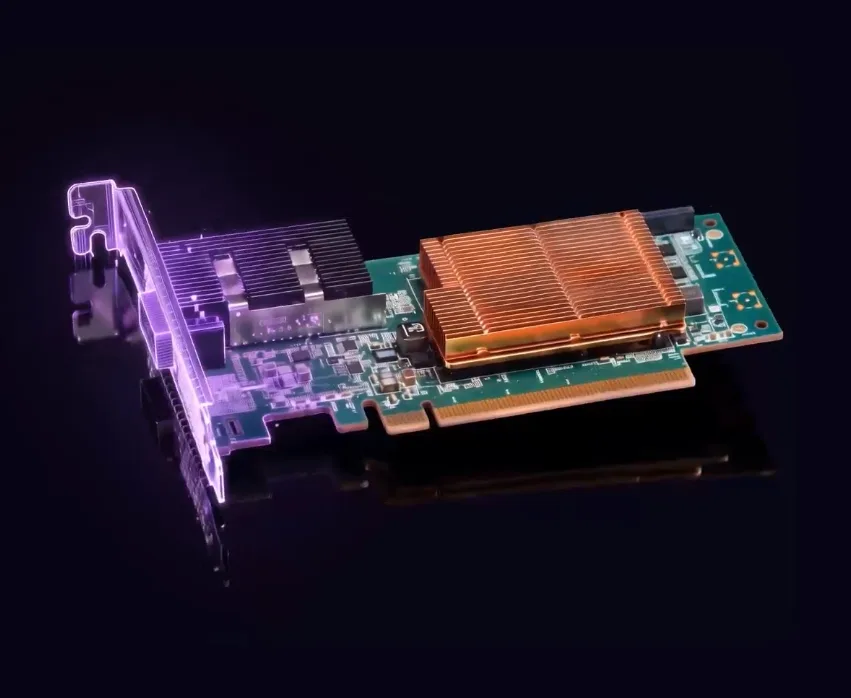
Cornelis Networks, a Pennsylvania company that makes networking hardware for AI and high-performance computing (HPC) clusters, raised about $205m, it announced on 14 September 2026. IAG Capital Partners led the round, which the Philadelphia Business Journal described as a Series C, according to MyChesco.
The company did not name other investors or disclose a valuation. The Philadelphia Business Journal called it the largest reported venture round in the Philadelphia region in 2026, MyChesco reported.
Cornelis announced the funding together with a new architecture called Active Compute Fabric, which marks its entry into scale-up networking, and a collaboration with Qualcomm Technologies.
“AI infrastructure is reaching a point where faster endpoints alone are not enough. The fabric has to become an active part of the compute system.”Lisa Spelman, CEO, Cornelis
What Cornelis does
Cornelis spun out of Intel in 2020, taking over the technology and expertise of Intel's Omni-Path high-performance networking business, VKTR reported. Its products include network interface cards, switches and software. The company said its technology already runs AI and HPC workloads in hundreds of data centres. Its CN5000 products are shipping, and its CN6000 is sampling with customers, with wider availability expected in the fourth quarter of 2026.
The company is based in Wayne, Pennsylvania, in Tredyffrin Township, and has grown from about 40 employees in 2020 to more than 250, MyChesco reported. Lisa Spelman is chief executive.
Until now Cornelis focused on scale-out networking, which links racks of servers together. Active Compute Fabric extends it to scale-up networking, which connects accelerators inside a rack. The architecture combines lossless transport, in-fabric acceleration and programmable compute, so that the network can process data as it moves and take over collective operations that would otherwise leave GPUs waiting. It uses open standards, UALink and ESUN for scale-up and Ultra Ethernet for scale-out, and supports a range of accelerators.
"AI infrastructure is reaching a point where faster endpoints alone are not enough. The fabric has to become an active part of the compute system," Spelman said in the announcement.
What the money is for
Cornelis said the funding will support its move into scale-up networking, development of its next-generation scale-up and scale-out roadmap, and CN6000 manufacturing and customer deployments. It also plans to scale production, deepen customer partnerships and expand its go-to-market efforts.
The company made the case for its approach with its own modelling. For a 100,000-GPU system, it estimated that about half of all GPU hours are spent waiting for data, worth about $1.68bn a year in unused capacity at $4 per GPU-hour. These are company projections based on simulation, not measured results.
Joel Whitley, a partner at IAG Capital Partners, said in the release that open-standard scale-up and scale-out networking for AI represents more than $55bn of opportunity by 2030.
The funding so far
IAG Capital Partners has backed Cornelis before. It led the company's $29m Series B in November 2022, in which Adit Ventures, Foresight Group, Intel Capital, KittyHawk Ventures, Ridgeline Partners and SQN Venture Partners also invested.
When it spun out of Intel in 2020, Cornelis raised a $20m Series A led by the London fund Downing Ventures, with Intel Capital and Chestnut Street Ventures taking part, eeNews Europe reported. The company has not disclosed its total funding.
Competing with Nvidia
VKTR described Cornelis as building an open alternative to the networking technology that connects chips in AI systems, a market led by Nvidia. Cornelis is not trying to build its own accelerator. Its collaboration with Qualcomm Technologies covers validation work toward future rack-scale AI data-centre designs. Tony Pialis, who runs Qualcomm's data-centre business, said in the release that moving data efficiently across the rack is becoming as important as the compute itself.
Company website: cornelis.com