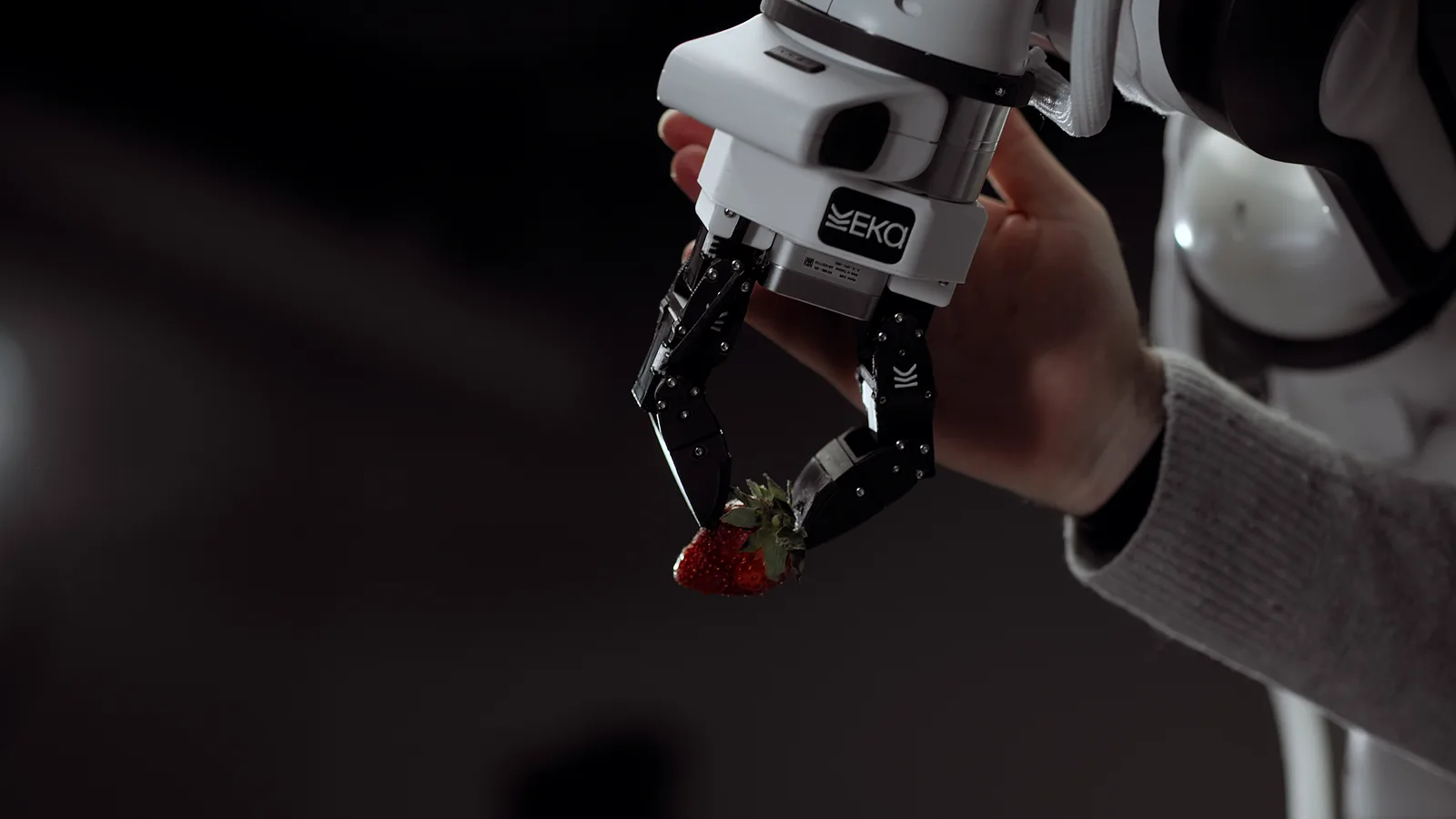
Eka Robotics, a startup in Cambridge, Massachusetts that builds AI models for robot manipulation, has raised $150m in a Series A round. It announced the round on 20 October 2026.
Andreessen Horowitz and F-Prime co-led the round. The seed investors Obvious Ventures and E14 Fund returned, and MFV Partners, Bison Ventures, Glasswing Ventures, Samsung Next and unnamed Fortune 500 companies also invested, Eka said in a blog post.
The company did not disclose a valuation. Tech Funding News, citing TechCrunch, reported a post-money valuation of $1.45bn.
“Eka's Vision-Force-Action model is the first approach I've seen that truly solves manipulation”Raghu Raghuram, General Partner, Andreessen Horowitz
What Eka Robotics does
Eka is building what it calls a Vision-Force-Action model, an AI system that uses touch and force as well as camera images to control robot grippers. Eka argues that handling real objects reliably requires a robot to feel what it is doing, not only to see it.
The model is trained with reinforcement learning in simulation, where Eka said it can generate thousands of hours of robot experience in minutes while varying objects, environments and physical conditions, before the skills are moved onto real hardware. The company compared the method to DeepMind's AlphaZero, which reached superhuman play in chess and Go without human data. Tech Funding News reported that Eka also built a custom gripper with more force sensors than a standard one.
According to Tech Funding News, the company's robot performs about 1,500 operations an hour on its target tasks, against a human baseline of about 600. Eka said the robot handles a wide range of objects outside its training data, and that the same machine can screw in a light bulb and insert wires.
Eka was founded by Pulkit Agrawal, an associate professor at MIT who previously co-founded SafelyYou, and Tuomas Haarnoja, a former Google DeepMind researcher and co-creator of the Soft Actor-Critic reinforcement learning algorithm. The two met as graduate students at UC Berkeley, Tech Funding News reported. According to the same report, SafelyYou uses computer vision to reduce falls among people with dementia, and Haarnoja's work at DeepMind included training small humanoid robots to play soccer.
Who invested
Raghu Raghuram, a general partner at Andreessen Horowitz, gave the strongest endorsement in the announcement, saying Eka's model is the first approach he had seen that truly solves manipulation.
F-Prime, the co-lead, is affiliated with FMR, the parent company of Fidelity. Kahini Shah, a partner at Obvious Ventures, summed up the bet in three words: "Team and Dream." She said it was clear the founders are among the best roboticists in the world. Habib Haddad, founding managing partner of E14 Fund, said Agrawal and Haarnoja had understood that teaching robots to imitate humans does not make them work reliably at higher speeds, and that robots need to build an intuition for the physical world.
Shyam Kamadolli, a managing director at Fine Structure Ventures, said a robot's value on the factory floor comes down to its success rate and speed over thousands of repetitions, and Eka's approach is the only one that will hold up in real-world deployments of complex tasks.
What the money is for
Eka said it will use the funding to extend its model to more tasks, expand what its robots can do and speed up deployments with customers. It did not name customers.
The size of the seed round was not disclosed, and Eka has not said when it was founded or how many people it employs.
Eka's pitch to investors is that force sensing is what will make robot hands fast and reliable enough for real work, and the backers quoted in its announcement said that approach is what persuaded them.
Company website: ekarobotics.com