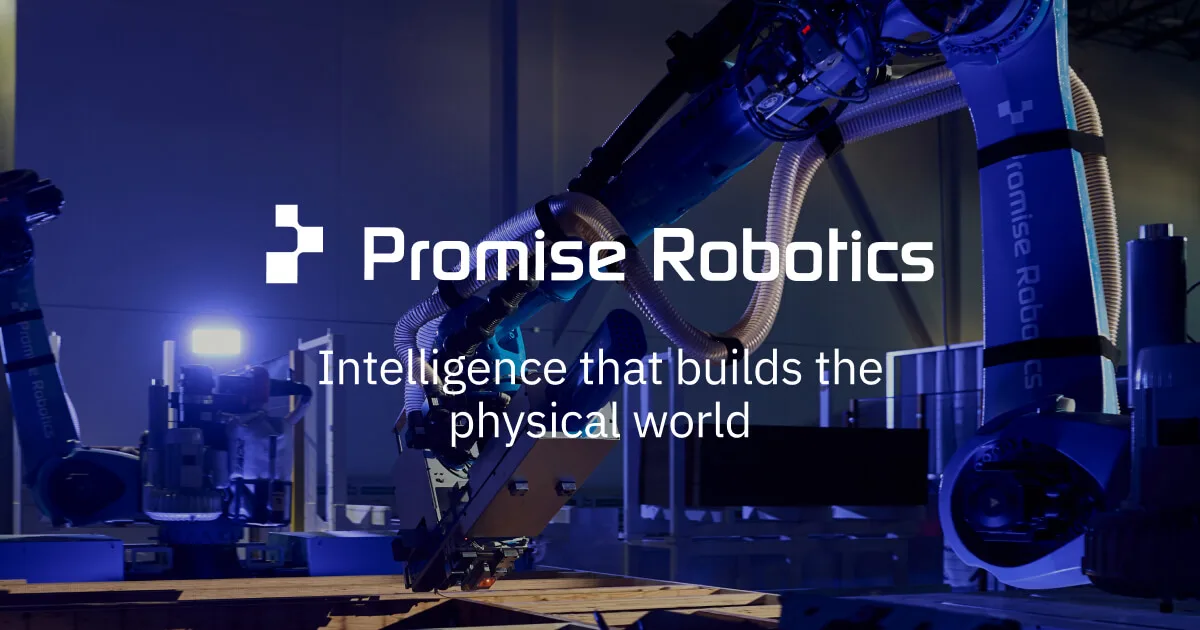
Promise Robotics, a Canadian company that uses AI software and robots to manufacture structural components for houses, announced on 17 November 2026 that it had closed a C$40m (about $28m) Series B round.
White Star Capital led the round. Horizons Ventures, Radical Ventures and the Public Sector Pension Investment Board (PSP Investments), a Canadian pension fund, also took part. The company did not disclose a valuation or its total funding to date.
Promise said the money will be used to extend its network of production sites across North America. BetaKit reported that the company also plans to spend on research and development and to hire more staff. The round was announced a few weeks after Promise signed a multi-year agreement with D.R. Horton, the largest homebuilder in the United States by volume.
“Homebuilding can't scale on trade labor alone, and builders shouldn't have to become manufacturers to grow. We're building the production infrastructure the industry can scale on; a network of intelligent factories that get better with every home it helps build. This round lets us extend that network across North America.”Ramtin Attar, CEO and Co-founder, Promise Robotics
What Promise Robotics does
Promise sells what it calls Factory-as-a-Service. A homebuilder supplies its existing house designs, and the company's software turns them into production plans for robotic equipment. Promise's own factories then make precision structural components such as wall panels, which the builder's crews assemble on site. Builders pay for the output rather than investing in and running factories of their own.
The company pitches this as a way for builders to add capacity at a time when skilled construction labour is scarce and opening new plants market by market is slow and expensive. It said it has spent the past six years developing its technology, testing its business model and expanding into new markets.
Promise has production running in Calgary and in Nisku, near Edmonton, in Alberta. It said it has more than 2,500 housing units under contract across three markets. BetaKit described the company as based in Toronto, while the announcement itself was issued from Phoenix. According to BetaKit, which cited The Globe and Mail, Promise has 85 employees and plans to grow beyond 100.
The D.R. Horton deal and a first U.S. plant
D.R. Horton is the first large U.S. homebuilder to use the Factory-as-a-Service platform, according to Promise. The Next Web reported that the multi-year agreement covers help in producing more than 1,250 homes. Financial terms were not disclosed.
To serve the U.S. market, Promise plans its first American facility in Phoenix, Arizona, which it expects to open in 2027. The company did not give the cost of the plant or its planned output.
Who invested
White Star Capital is a multi-stage technology investor with offices in cities including Toronto, Montreal, New York, London and Paris. Sanjay Zimmermann, a general partner at the firm, said in the announcement that from its first meetings with the team it was clear that no one else was building what Promise was building, and he pointed to the D.R. Horton agreement as evidence of how the company executes across builders and markets.
Horizons Ventures, Radical Ventures and PSP Investments are listed alongside White Star as investors in the company. The announcement did not say how much each investor put in or whether any of them had backed earlier rounds.
The funding so far
Promise last raised a $15m Series A in 2023, according to The Next Web, which did not name the investors in that round. The company described its approach to growth as measured and capital-efficient but did not give a total for the money it has raised.
Construction robotics has drawn other investment this year. The Next Web noted that Berlin-based All3 raised $25m in April for legged robots that work on building sites, and that Dutch startup Monumental is developing bricklaying robots. Trade publication Plant also reported the Promise round, with the same amount and investors.
Company website: promiserobotics.com