Universal Quantum, a quantum computing company spun out of the University of Sussex, said on 8 October 2026 that it had raised more than $100m in a Series A round. DCVC, the Silicon Valley deep-tech investor, and Firgun Ventures, a fund that specialises in quantum companies, co-led the financing.
The company says the deal is the largest Series A ever raised by a quantum firm headquartered in the UK. The university called it a record for one of its spinouts and one of the largest investments in any UK university spinout. It is the company's first significant funding round. No valuation was disclosed.
Tech.eu reported that Universal Quantum has now raised more than $125m in total. Lazard acted as exclusive financial adviser to the company on the transaction.
“Universal Quantum’s progress reflects our partners’ belief that we represent one of the most credible paths to quantum computing at scale. This round unites an extraordinary group of investors from the world’s most important pools of capital around a single mission: delivering utility-scale quantum computing.”Dr Sebastian Weidt, Co-founder and CEO, Universal Quantum
What Universal Quantum does
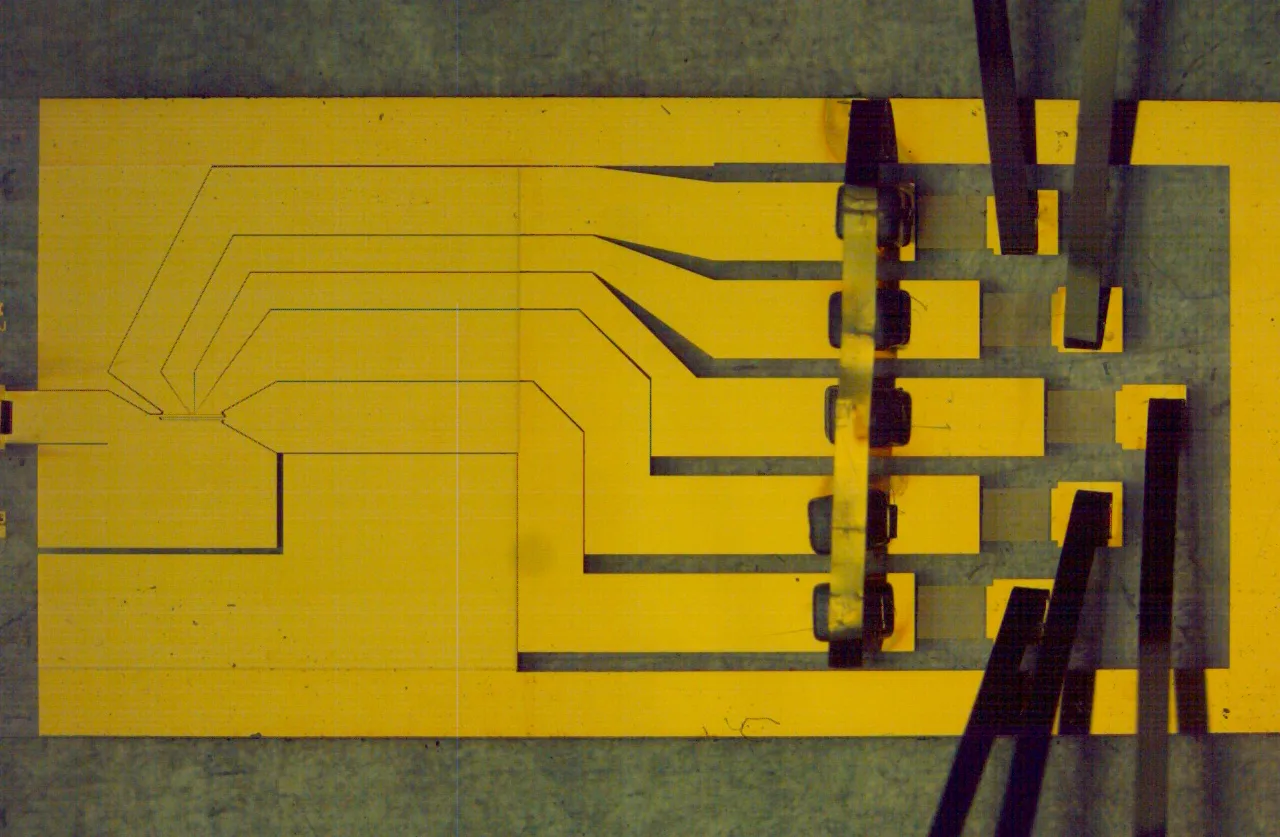
Universal Quantum builds quantum computers by linking, or tiling, many small trapped-ion chips instead of making one ever-larger processor. In a trapped-ion machine, charged atoms held in place by electric fields act as qubits. The company says its modular approach does not depend on photonic interconnects or on large, expensive lasers and cooling equipment, and is designed to reach the scale needed for fault-tolerant, error-corrected computing.
According to Tech.eu, the company's chip, the iQPU, is produced on a standard 200mm commercial foundry line and is controlled with microwaves rather than lasers. A proprietary link called UQConnect joins chips together. Tech.eu also reported that the machines run at room temperature and that Rolls-Royce is working with the company on computational fluid dynamics for aerospace.
Professor Winfried Hensinger and Dr Sebastian Weidt of the Sussex Centre for Quantum Technologies founded the company in 2018. In 2017 they co-wrote the first practical blueprint for a large-scale trapped-ion quantum computer. Weidt is chief executive. The company is headquartered in Haywards Heath in Sussex, has sites on three continents and employs more than 100 people.
Who invested
Besides the two leads, the round drew EDBI, the Singapore sovereign investor; Artal, which is advised by Invus; the Japanese asset manager Integral GlobalTech; and the Australian investors Main Sequence, Hostplus and NGS Super. IAG Capital, EdenBase, Eigenstate Holdings and Roblox founder and chief executive Dave Baszucki also took part, as did existing and new strategic backers including Nauta Capital and The Venture Collective. The university's announcement also listed Full Disclosure; the published investor lists differ slightly between announcements.
James Hardiman, a general partner at DCVC, said the modular design addresses the hardest problems in scaling ion-trap systems. Bill Bartee, managing partner at Main Sequence, pointed to the contracts the company has already won, saying its paying customers include demanding scientific and government institutions.
What the money is for
Universal Quantum will spend the money on developing and commercialising its modular technology, including the chiplet arrays and control systems needed for larger machines. The round also funds its first research and development centre outside Europe, in Singapore, and expansion in the US, Japan and at its German hub in Hamburg.
The company says it is delivering a $77m contract with the German Aerospace Center (DLR). Tech.eu put the original 2023 award at €67m. The university said the company's growth supports plans for a cluster of quantum businesses in the Sussex and Brighton area, which it calls a 'Quantum Silicon Valley'.
A busy market for quantum hardware
The round adds to a run of large investments in quantum computing. Universal Quantum cited analyst forecasts that the quantum technology market could be worth $60bn to $100bn a year by 2035. Tech.eu noted that the company is based outside the Oxford, Cambridge and Bristol clusters where many UK deep-tech start-ups are located.
Company website: universalquantum.com